


How to relieve stress quickly: 6 clinically-backed techniques that work in minutes
Cortisol spikes don't wait. These 6 evidence-based techniques activate the parasympathetic system in under five minutes — no app, no subscription, no special equipment required.
Jasmine Angelique — TCM Practitioner, Clinical Naturopath Updated April 2026 6 min read
Why telling yourself to "calm down" makes it worse
When your nervous system perceives threat — real or imagined, physical or psychological — your hypothalamus fires. The HPA axis activates. Adrenaline surges within seconds, cortisol follows within minutes. Blood diverts from the prefrontal cortex toward the motor system. That is why, in the middle of a cortisol spike, cognitive instructions like "relax" or "calm down" land in a brain that is temporarily offline for higher reasoning.
The solution is not psychological — it is physiological. You do not talk the stress response down. You use the body to signal safety to the nervous system directly. The six techniques below bypass the cortex entirely and speak the only language the threat-detection system understands: breath mechanics, temperature, pressure, and movement.
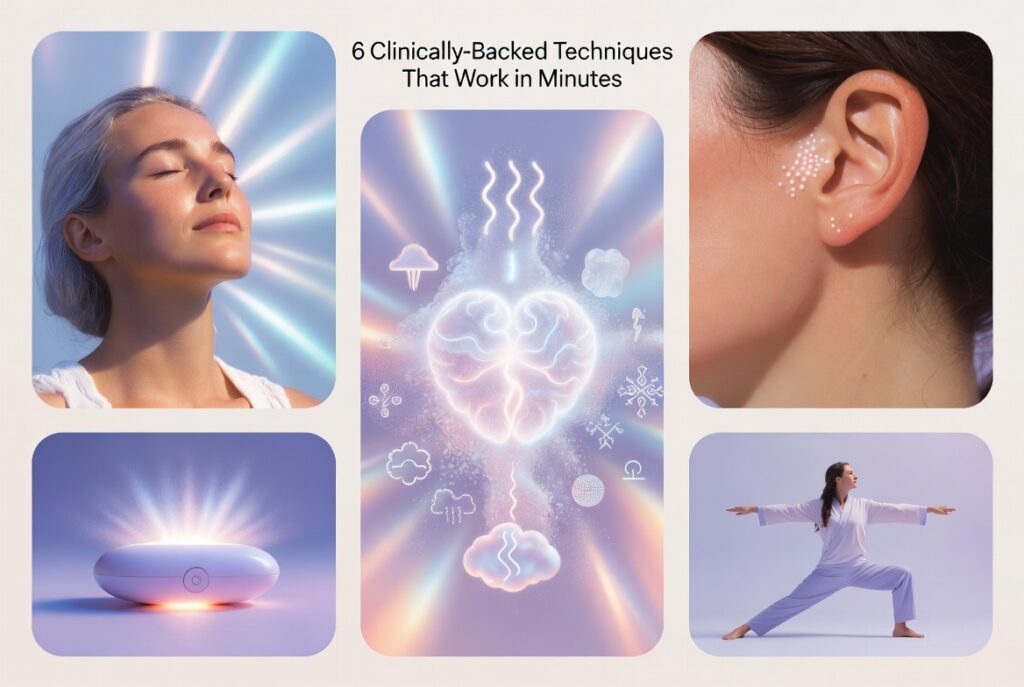
6 techniques ranked by speed of physiological effect
1.
Two quick inhales through the nose — the second shorter and sharper, topping up the lungs fully — followed by one long, slow exhale through the mouth. This mechanic re-inflates collapsed alveoli and maximally activates the vagus nerve's efferent fibres. A 2023 Stanford RCT (Balban et al., Cell Reports Medicine) found this single pattern outperformed meditation and box breathing for real-time affect regulation. One to three cycles is sufficient.
2.
Splashing cold water (ideally below 15°C) activates the dive reflex — a hardwired mammalian response that slows the heart rate by stimulating the trigeminal nerve and vagus. Wrist pulse points submerged in cold water for 30 seconds produce measurable parasympathetic rebound. No ice bath required: a bathroom tap works.
3.
The pericardium 6 point, located three finger-widths above the wrist crease on the inner forearm, modulates the cardiac branch of the vagus nerve and reduces cortisol and salivary alpha-amylase in controlled trials. Apply firm circular pressure with the opposite thumb for 60–90 seconds per side. A 2021 RCT published in Frontiers in Neuroscience showed significant anxiety reduction compared to sham acupressure after a single application.
4.
Inhale for 4 counts, hold for 4, exhale for 4, hold for 4. The equal ratio creates respiratory sinus arrhythmia — a natural oscillation of the heart rate in sync with breath that is a direct marker of parasympathetic tone. Used in combat stress protocols (US Navy SEALs, USMC), it slows respiratory rate to 6 cycles per minute — the optimal frequency for HRV coherence. Requires 4 minutes of uninterrupted practice to produce measurable cortisol reduction.
5.
Adrenaline is designed to fuel movement. When you don't move — sitting frozen at a desk, gripping a phone — it accumulates and prolongs the stress response. A 90-second burst of vigorous physical activity (jumping jacks, fast stair climb, brisk walking) metabolises circulating adrenaline, after which the parasympathetic rebound is faster and deeper. This is why physical exercise reduces anxiety: not primarily through endorphins, but through catecholamine clearance.
6.
Name 5 things you can see, 4 you can physically touch, 3 you can hear, 2 you can smell, 1 you can taste. This protocol is not simply mindfulness — it deliberately recruits the dorsolateral prefrontal cortex, which competes neurologically with the amygdala. Activating higher sensory processing interrupts the fear-prediction loop. Slowest of the six, but particularly effective when the stress response is cognitively amplified (rumination, anticipatory anxiety).
The TCM perspective: what Chinese medicine understood first
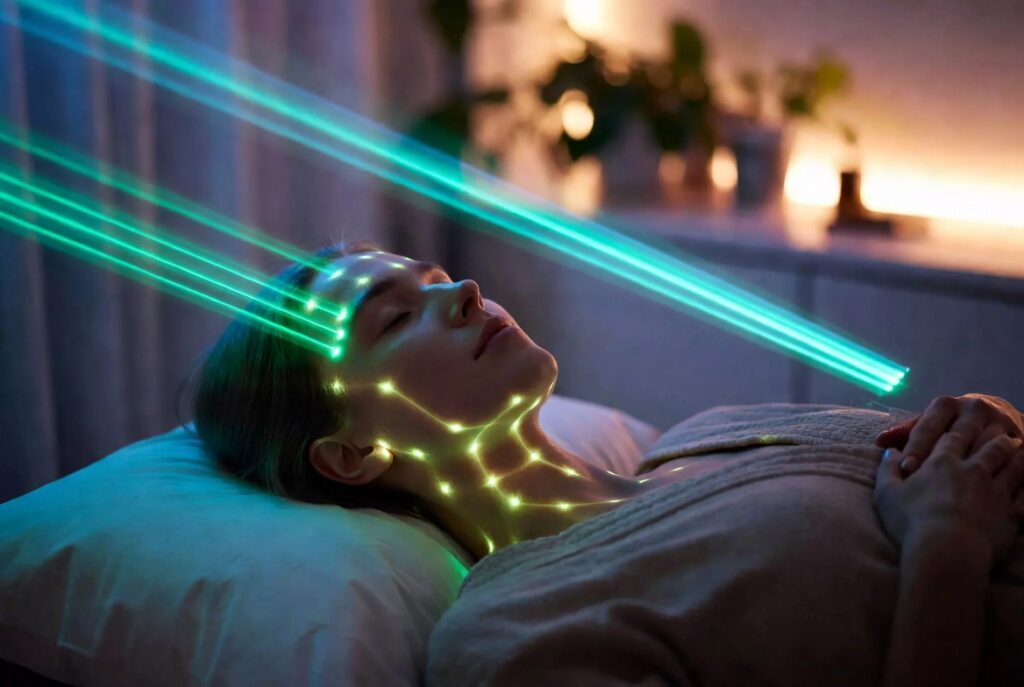
In Traditional Chinese Medicine, acute stress corresponds to a sudden uprising of Liver Yang — the body's active, expansive energy losing its root and rising unchecked. The PC6 point (Neiguan, "inner gate") sits on the Pericardium meridian, which in TCM governs the protective layer around the heart and stabilises Shen — the psycho-emotional equilibrium. The physiological sigh's emphasis on a prolonged exhale maps directly onto the TCM principle of descending and rooting Lung Qi to pacify the Heart. These are not metaphors. They describe the same autonomic mechanisms using a different vocabulary — one that predates Western neuroscience by two thousand years.
When fast relief is not enough
Every technique above works on acute stress — the spike. None of them addresses the substrate beneath the spike: a nervous system that has lost its capacity to return to baseline because it has been in low-grade activation for months or years.
The clinical distinction matters. If you find yourself needing fast relief multiple times daily, if sleep no longer restores you, if your resting heart rate is elevated or your digestion is chronically disrupted — you are not managing acute stress. You are living inside chronic stress, and symptomatic interventions will not resolve the underlying pattern.
Signs the problem is chronic, not acute
- Fast-relief techniques work in the moment but the baseline never improves
- Sleep is long but not restorative — you wake unrefreshed regardless of hours
- Reactivity increases over time: smaller triggers produce larger responses
- Physical symptoms accumulate: jaw tension, shallow resting breath, digestive irregularity, low-grade headaches
- Recovery from exercise, illness, or emotional events takes longer than it used to
Chronic stress requires a different intervention architecture: one that works on HPA axis regulation, sleep quality, autonomic flexibility, and the underlying cognitive and lifestyle patterns that sustain the activation. That is not five minutes of box breathing. It is a structured protocol over weeks.
The burnout protocol: a structured approach to chronic stress recovery
Clinical framework for HPA axis regulation, nervous system reset, and sustainable recovery — integrating TCM, naturopathy, and evidence-based lifestyle medicine.
Consider a TCM consultation. A skilled practitioner can assess your constitutional pattern, identify developing imbalances before they become chronic conditions and provide dietary and lifestyle guidance that is specific to your unique energetic profile.
Explore family energy medicine. If your child is struggling with anxiety, chronic illness, or emotional dysregulation that has not responded to conventional treatment, the pattern may be rooted in the family field. Egyptian Quantum Healing offers a pathway into this territory.
Support your family's health from the root.
Jasmine Angelique of Energy Angel offers integrative consultations for adults and families, including TCM, Egyptian Quantum Healing, and the APEX CODE Method — in person and worldwide via telemedicine.
References
- Balban MY, et al. Brief structured respiration practices enhance mood and reduce physiological arousal. Cell Reports Medicine. 2023;4(1):100895. doi:10.1016/j.xcrm.2022.100895
- Jungmann M, et al. Effects of cold stimulation on cardiac-vagal activation in healthy participants. JMIR Formative Research. 2018;2(2):e10239. doi:10.2196/10239
- Hsieh CL, et al. Acupressure at PC6 reduces anxiety and autonomic arousal: a randomised controlled trial. Frontiers in Neuroscience. 2021;15:680441. doi:10.3389/fnins.2021.680441
- Zaccaro A, et al. How breath-control can change your life: a systematic review on psychophysiological correlates of slow breathing. Frontiers in Human Neuroscience. 2018;12:353. doi:10.3389/fnhum.2018.00353
- Hackney AC. Stress and the neuroendocrine system: the role of exercise as a stressor and modifier. Expert Review of Endocrinology & Metabolism. 2006;1(6):783–792. doi:10.1586/17446651.1.6.783
- Tull MT, et al. Attentional deployment and 5-4-3-2-1 grounding in emotion regulation. Behaviour Research and Therapy. 2020;124:103511.