




The Real Cost of the AI Tsunami Is Not Your Business Model — It’s Your People
Private equity buyouts just collapsed 36% in a single quarter. But the real disruption isn’t a deal slowdown — it’s the mass displacement quietly being planned inside your portfolio companies. Here’s why that’s the worst investment thesis in the room.
By Jasmine Angelique · Wellness Performance Coach · Integrative Medicine · Burnout Recovery for Executives & Organizations · Barcelona | London | Amsterdam | New York
📊 36% drop in PE buyout volume Q1 2026 | $172B total buyout value | 25% lower turnover in wellness-invested companies
The boardroom is freezing — and the temperature will keep dropping

Private equity’s first quarter of 2026 delivered a stark verdict. Buyout volumes dropped to $172 billion — a 36% quarter-over-quarter decline. Exits fell to $162 billion. The culprits are familiar: geopolitical shock from the ongoing Middle East conflict, and a deep, board-level anxiety about what agentic AI is actually going to do to business models over the next 18 months.
One European buyout leader called it “one of the most turbulent periods I can remember.” Others are using the word tsunami — and they don’t mean it metaphorically.
But here’s what I want to challenge: the instinctive response to volatility and AI disruption is almost always the same. Cut headcount. Automate the margin. Show the LP a cleaner EBITDA. Move fast before the wave arrives.
That reflex is understandable. It is also, at scale, dangerous — and not just for society. For your returns.
History’s pattern: unemployment destabilizes everything you’re trying to protect
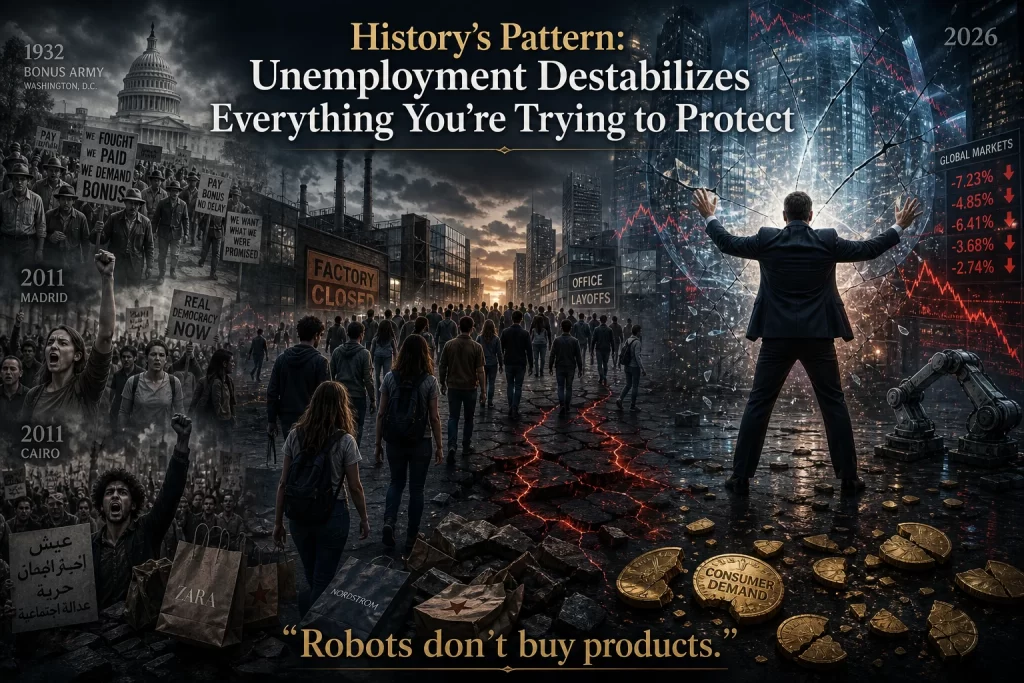
The relationship between mass unemployment and civil unrest is not a progressive talking point. It is one of the most consistently documented patterns in economic history.
- During the Great Depression, with unemployment peaking near 25%, the United States saw the Bonus Army protests turn violent, widespread hunger marches, and a political realignment that reshaped the country for a generation.
- The 2011 youth unemployment spikes across Southern Europe and the Arab world were directly correlated with the uprisings that followed — from the streets of Madrid to Cairo.
- Peer-reviewed research consistently identifies joblessness among people aged 18–34 as one of the strongest predictors of protest, riot, and in extreme cases, radicalization.
Current U.S. unemployment stands at 4.3% (April 2026). The UK, Spain, and the Netherlands are navigating their own fragile labor equilibria. These are not abstract numbers — they represent the consumer base that funds the revenues of every company you own, advise, or lead.
“Robots don’t buy products. Displaced workers lose spending power. Mass automation without demand-side strategy is a plan to shrink your own market.”
What burnout is already costing your organization — right now
Before we even reach the macro risk of mass layoffs, there is a quieter crisis already running inside your leadership teams. Executive burnout is not a wellness industry concept. It is a measurable performance leak that shows up in deal quality, decision latency, client retention, and team stability — often 6 to 12 months before it becomes visible.
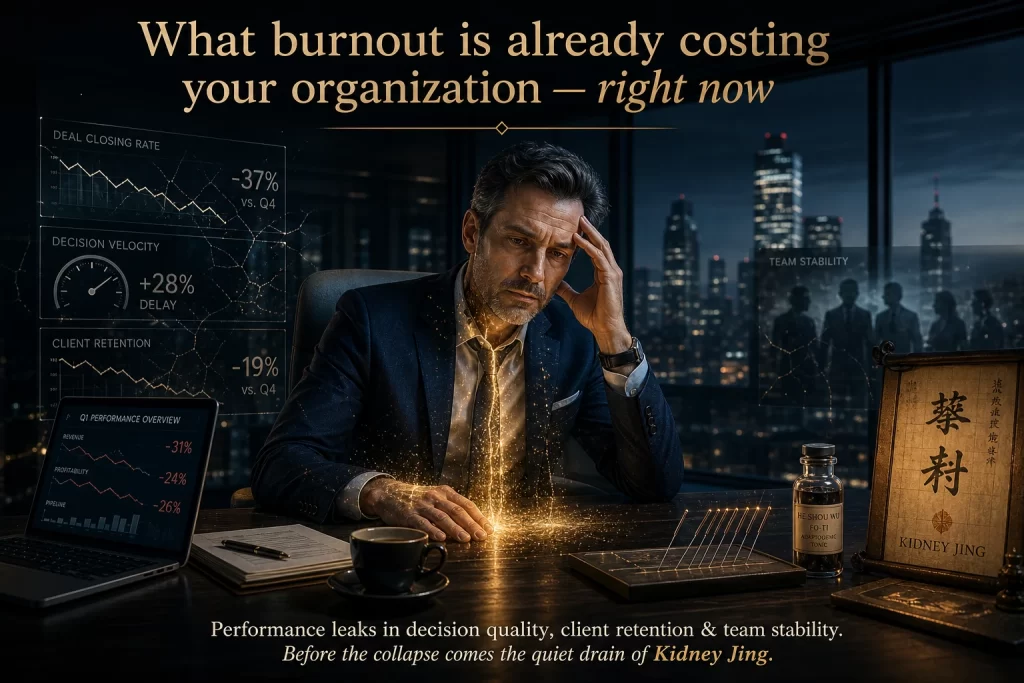
In Traditional Chinese Medicine, chronic overwork depletes what practitioners call Kidney Jing — the body’s deepest constitutional reserve. When that reserve is exhausted, no amount of caffeine, cold plunging, or motivational content restores it. What restores it is a structured clinical approach: acupuncture to regulate the nervous system, adaptogenic herbs to rebuild adrenal function, and a protocol designed specifically for high-output individuals.
→ Read the full clinical framework for executive burnout on medicinacinese.ch (medicinacinese.ch/en/burnout-executives)
The wellness ROI that CFOs keep ignoring
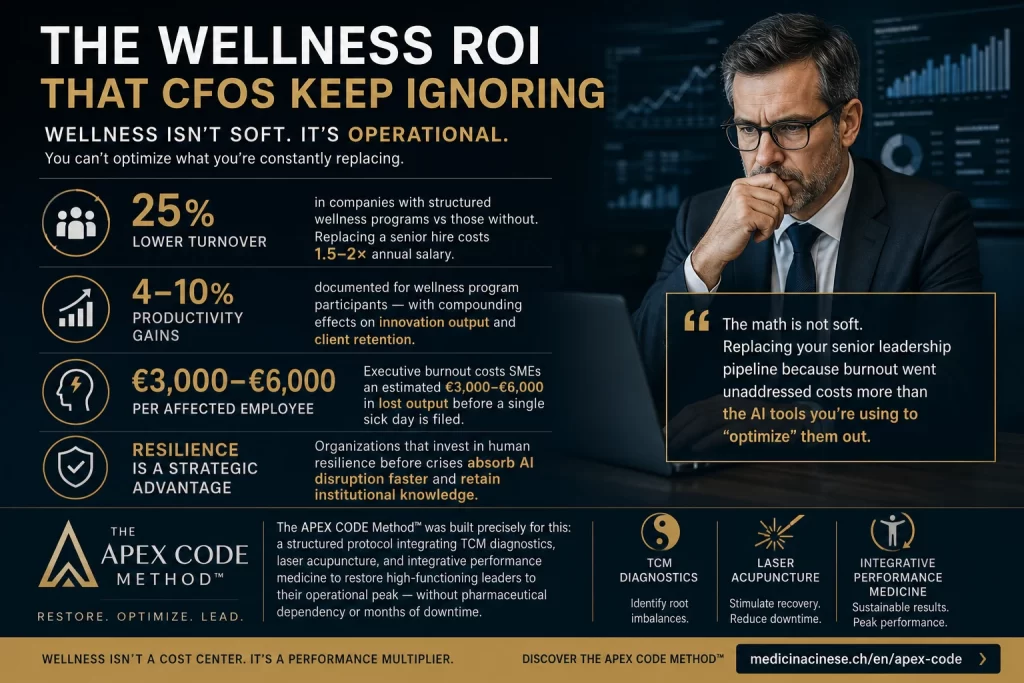
This is where the conversation usually stalls. Wellness feels soft. Performance data feels harder. So let’s talk in the language of operational returns.
Performance data at a glance:
- 25% lower employee turnover in companies with structured wellness programs vs those without. Replacing a senior hire costs 1.5–2× annual salary.
- 4–10% productivity gains documented for wellness program participants — with compounding effects on innovation output and client retention.
- Executive burnout costs SMEs an estimated €3,000–€6,000 per affected employee in lost output before a single sick day is filed.
- Organizations that invest in human resilience before crises absorb AI disruption faster and retain institutional knowledge.
The math is not soft. Replacing your senior leadership pipeline because burnout went unaddressed costs more than the AI tools you’re using to “optimize” them out. The APEX CODE Method™ was built precisely for this: a structured protocol integrating TCM diagnostics, laser acupuncture, and integrative performance medicine to restore high-functioning leaders to their operational peak — without pharmaceutical dependency or months of downtime.
What this means for founders, CEOs, and decision-makers right now
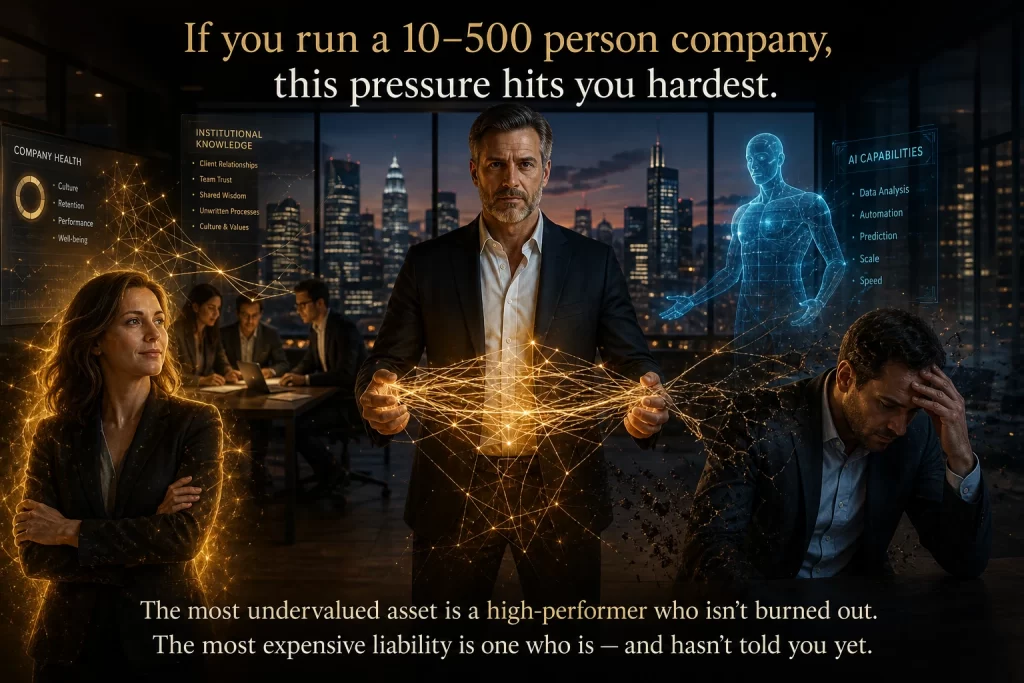
If you are running a company with 10 to 500 people — in technology, healthcare, legal, consulting, or sports — you are sitting at the exact intersection where this pressure hits hardest. You don’t have the slack of a 10,000-person enterprise. Every departure from your leadership team is felt. Every burnout episode in your top performers shows up in client work within weeks.
The question is not whether AI will change your workforce. It will. The question is whether you navigate that change as a company that invests in the people who will work alongside the AI, or as one that simply removes them and hopes the models fill the gap.
They won’t. Not yet. And by the time they can, you’ll have lost the institutional knowledge, client relationships, and organizational culture that made your company worth acquiring in the first place.
💡 The most undervalued asset in your company right now is a high-performer who isn’t burned out. The most expensive liability is one who is — and hasn’t told you yet.
A practical framework: three moves for SME leaders navigating AI disruption
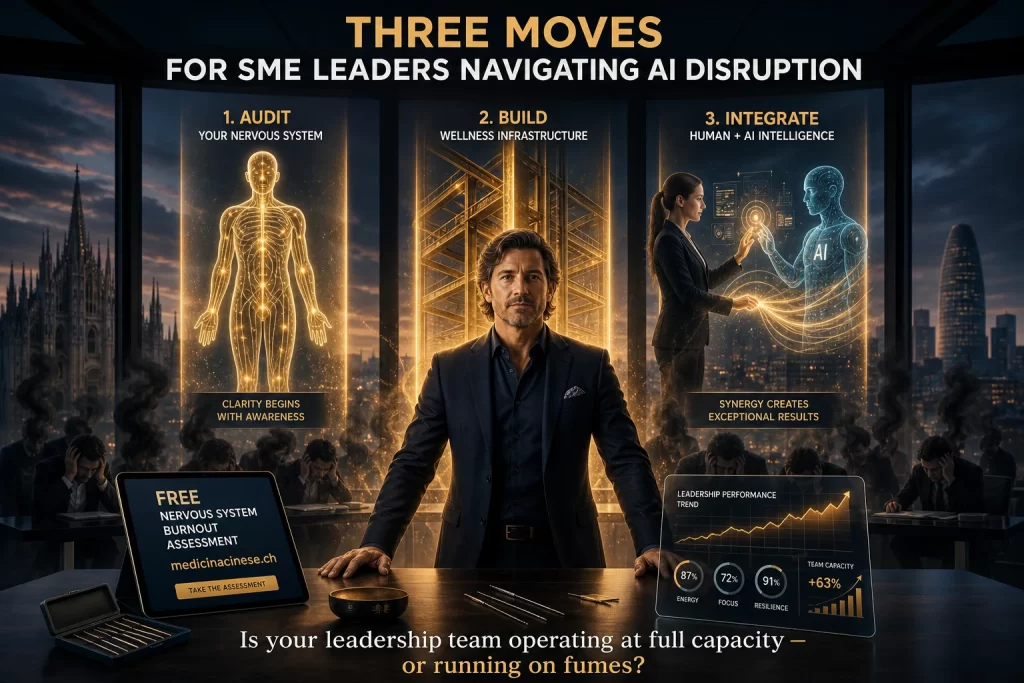
- Audit your team’s resilience before your next restructure. Burnout among founders and senior leaders typically predates broader organizational dysfunction by 6–12 months. Proactive assessment is cheaper than reactive crisis management. Start with our free nervous system burnout assessment — it takes under 4 minutes.
- Reframe wellness investment as operational infrastructure, not HR overhead. The same discipline you apply to IT infrastructure or legal compliance should apply to executive performance and nervous system regulation. It is not a perk. It is a risk management tool.
- Position your people to work with AI, not against it. The companies that will capture AI’s upside are not the ones that cut fastest. They are the ones whose teams are cognitively sharp, adaptable, and not running on cortisol and adrenaline. Human-AI collaboration requires high-functioning humans.
Is your leadership team operating at full capacity — or running on fumes?
I work with founders, CEOs, VPs, and directors across the Netherlands, UK, Spain, and USA to prevent executive burnout, restore peak performance, and build human-AI ready organizations. In-person in Barcelona. Worldwide via telemedicine.
👉 Book a free 20-min discovery call
What is your read on this? Is your organization leaning into human resilience — or betting everything on the model? I’d genuinely like to know where you’re landing on this.
Read more
Read the full clinical framework for executive burnout