


You are not “just stressed” when your body is wired and exhausted at the same time and nothing seems to switch it off. If you have been searching the Ankh healing symbol and the Egyptian quantum healing meaning, you are probably looking for something that ancient symbolism alone cannot give you: a way to actually calm a nervous system that has been stuck in overdrive for months.
The Ankh is an ancient Egyptian hieroglyph meaning “life” — breath, vitality, continuity. In modern wellness language it has become shorthand for balance and energetic restoration. This article connects that symbolism to something concrete: energy healing, acupuncture, and a realistic path back to calm — and, because the body responds to the work whether you are in the room or on a screen, something you can begin from anywhere in the world. I will be honest throughout about what is evidence-based, what is symbolic, and what is simply a useful ritual.
What is the Ankh healing symbol?
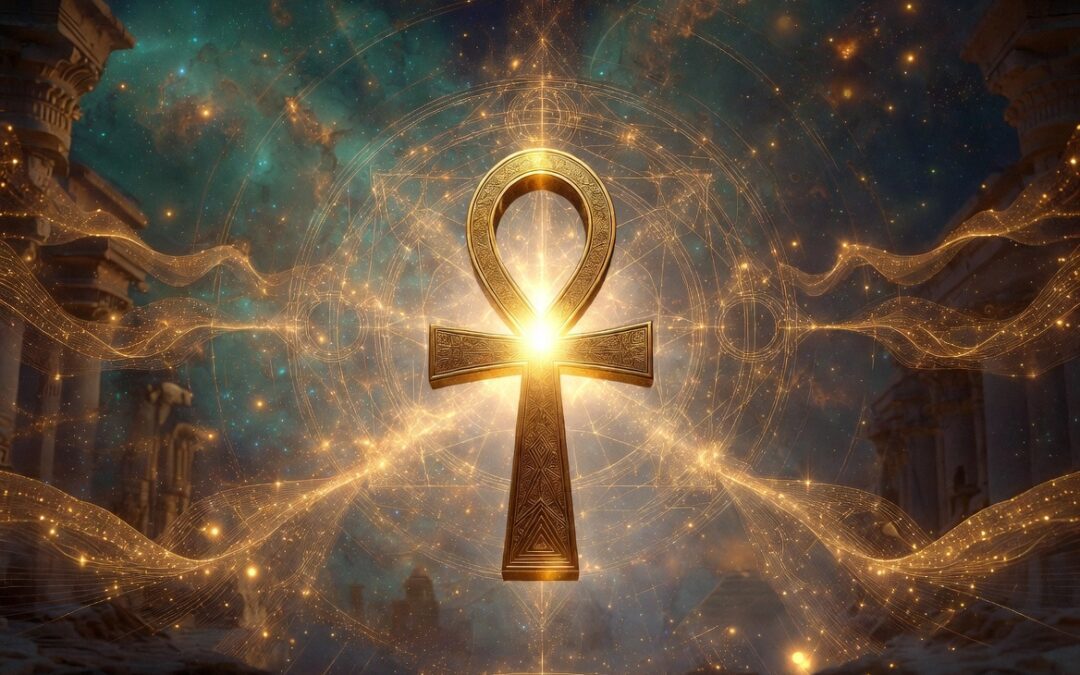
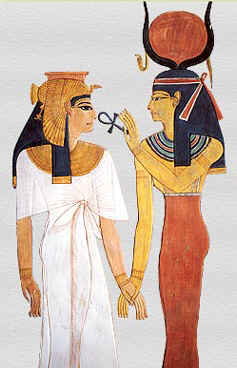
The Ankh is one of the most recognisable signs from ancient Egypt: a cross topped with a loop, carried by gods and pharaohs in temple art as the “key of life.” It represented life itself, the breath that animates the body, and the continuity between this life and the next.
In contemporary healing circles, people use the Ankh as a visual anchor — a reminder to move from depletion back to steadiness. That is its honest modern function: not a device that transmits energy, but a cue that helps you slow down and commit to recovery.
The Ankh is an ancient Egyptian hieroglyph meaning “life” — breath, vitality and continuity — often called the “key of life.” In modern wellness it is used as a symbolic anchor for restoration and balance. The symbol itself is not a treatment; it is a reminder to choose one.
Takeaway you can use today: if a symbol helps you pause and decide to take your recovery seriously, that is reason enough to keep it on your desk or screen. Just keep it as the prompt, not the cure.
Connection Between Heaven and Earth
The Ankh acts as a conduit between the cosmic and the physical, the eternal and the temporal. Its loop — the shen ring, representing the sun and the infinite — sits above. The crossbar and vertical stem extend into the horizontal and downward planes of earthly life. Together, the form encodes a specific instruction: from stillness into form, from the eternal into the manifest.
Ancient Egyptian artwork is precise on this point. In bas-reliefs across the New Kingdom temples, gods hold the Ankh to the nose and mouth of Pharaohs — the breath. This was not ceremony for its own sake. The breath is the fastest pathway between the voluntary and autonomic nervous systems, between the conscious mind and the subcortical structures that govern biological survival response. What the Egyptians understood intuitively, polyvagal theory (Porges, 1994) confirms: that deliberate breath-anchored transmission can shift the entire neuroceptive baseline of a human being.
The Ankh, held at the breath, was a coherence instrument. Its geometry provided the reference frequency. The breath provided the pathway.
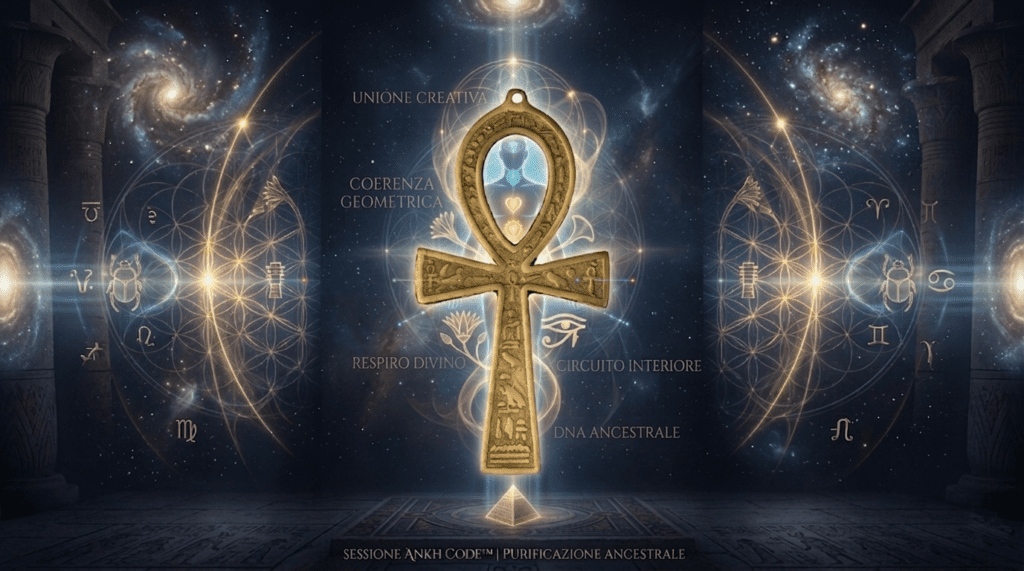
The Ankh as the Union of Creative Forces
Here is the knowledge most introductions to the Ankh omit. Across multiple esoteric traditions, the Ankh is understood as a representation of the union of masculine and feminine creative principles. The loop at the top symbolises the feminine — the womb, the Sophia, the unmanifest that holds all potential. The vertical stem represents the masculine impulse — direction, descent into form. The outstretched arms are the life created from their union.
At the cosmic level, this is the merging of Osiris and Isis, of yin and yang, of the receptive and the generative. The Ankh encodes the primordial act of creation not as metaphor, but as geometric instruction.
This is why the Ankh also carries deep meaning in the context of prana — life-force energy — and why across multiple ancient traditions (Egyptian, Tantric, Taoist, Kundalini), the same circuit is described: vital energy rising through the spine, capable of being retained and circulated through the energetic body rather than dissipated. The Egyptians called this directing the energy into the ankh channel — a loop that, when activated, returns the concentrated life-force back through the body as a regenerative current rather than allowing it to discharge outward. This is the deeper meaning of the Mer-Ka-Ba: the energetic lightbody sustained by coherent, circulating life-force.
This is not a peripheral or esoteric footnote to Egyptian healing. It is central to it. The Ankh was the key — literally — to this inner circuit. The Key of Life.
Geometric Coherence and Vibrational Depth

Understanding why the Ankh works requires understanding what geometry does in biological systems.
The Power of Sacred Geometry
Sacred geometry is not a belief system. It is an observation: that nature organises itself according to recurring mathematical relationships and that living systems exposed to coherent geometric templates tend to entrain toward coherence themselves. This is the principle behind cymatics, behind the coherent emission patterns of healthy tissue studied by biophysicist Fritz-Albert Popp and behind the clinical application of structured laser frequencies in photobiomodulation.
The Ankh’s geometry is not arbitrary. It encodes the zero-point (the loop, the still centre), the horizontal axis of the present moment (the crossbar) and the vertical axis of above-to-below transmission (the stem). When held in focused attention — or when used by a trained practitioner as a coherence anchor in a clinical session — this form provides a reference frequency against which a disorganised biofield can re-order itself.
The body is an oscillating system. Every cell emits biophotonic light. Every organ system has a dominant frequency. Coherence is health; incoherence is the precursor to dysfunction. The Ankh, as a coherence template, speaks directly to this biological reality — which is why it was not merely displayed, but used.
Amplifying Energy Through Pyramid Geometry
The pyramid is the Ankh’s architectural complement. Where the Ankh encodes the loop and the cross — the vertical flow and the horizontal expansion — the pyramid encodes the convergence of energy toward a single point: the apex, the zero-point, the still centre.
Egyptian healing architecture was not coincidental. The precision of orientation in relation to celestial axes, the mathematics of the slope angles, the acoustic properties of the internal chambers — these are not the features of a monument. They are the features of a precision instrument for working with subtle energy at scale.
In clinical application, pyramid geometry functions as a focusing lens — concentrating coherent frequency input rather than diffusing it. This is part of why the ANKH CODE™ protocol incorporates sacred geometry as an active structural element, not background symbolism. The session is built on the same principle: geometry as functional architecture for healing.
What does Egyptian quantum healing mean?
When people search “Egyptian quantum healing meaning,” they usually want a bridge between ancient symbolism and modern energy work. The most truthful framing is not a medical claim but a wellness one: a practice that uses imagery, intention, and ritual to support calm, reflection, and a felt sense of coherence.
The word “quantum” here is metaphorical, not clinical. There is no robust evidence that any symbol or ritual produces effects through quantum physics. What there is good evidence for is that intentional, ritualised practices — meditation, breathwork, focused attention — shift the autonomic nervous system toward its calming, parasympathetic state. That is the real mechanism worth your attention.
Egyptian quantum healing is best understood as a symbolic wellness practice, not a medical treatment. It uses Egyptian imagery, intention and ritual to support calm and focus. There is no evidence it works through quantum physics; its real value lies in how ritual and focused attention help regulate the nervous system.
Takeaway you can use today: define the practice in plain language for yourself — what it is, what it is not, and what you want from it. Clarity is what turns a pretty idea into a practice you will actually keep.
Is quantum healing the same as Reiki?
They overlap but are not identical. Both belong to the family of biofield or energy-based wellness practices, and both rely heavily on intention, calm presence, and ritual structure. Reiki is a specific Japanese system with defined hand positions and attunements; “Egyptian quantum healing” is a looser, modern framing built around Egyptian symbolism such as the Ankh.
What they share matters more than what divides them: the documented benefit in both cases comes largely from the relaxation response — slowed breathing, lowered heart rate, a nervous system that finally feels safe enough to downshift. Importantly, neither one requires physical touch to do that, which is why both adapt well to remote sessions.
Takeaway you can use today: choose the practice whose language and imagery you actually connect with. The ritual you will keep doing beats the “correct” one you abandon.
How do natural medicine and acupuncture support stress and fatigue?
This is where symbolism gives way to something measurable. Acupuncture acts directly on the stress physiology behind burnout: it stimulates afferent nerve fibres that engage parasympathetic pathways via the vagus nerve, which can lower heart rate and cortisol and raise heart-rate variability (HRV).
The evidence is encouraging while still maturing. A meta-analysis of 20 randomised controlled trials in generalised anxiety disorder found acupuncture more effective than control conditions, with a standardised effect size of −0.41 — a small-to-moderate benefit, with good tolerability. A more recent 2025 meta-analysis of 14 sham-controlled trials (968 participants) reported that acupuncture outperformed sham acupuncture on anxiety and sleep measures, and even produced small reductions in circulating cortisol — though the authors note that effect sizes are modest and certainty varies. Both the US NCCIH and the NHS recognise acupuncture as a reasonable, low-risk option for stress-related symptoms when performed by a trained practitioner.
Acupuncture supports stress and fatigue by activating the vagus nerve and the body’s parasympathetic “rest and recover” state, which can lower heart rate and cortisol and raise heart-rate variability. A 20-trial meta-analysis found a small-to-moderate benefit for anxiety (effect size −0.41), and a 2025 sham-controlled review found acupuncture beat placebo needling on anxiety, sleep and cortisol. It works best as complementary care alongside sleep, breathwork and, where needed, conventional treatment.
For the practical, at-home side of this, see How to Feel Lighter in Body and Mind Naturally and Harness Your Inner Power: Holistic Energy Practices.
Takeaway you can use today: pair the symbolic language of the Ankh with concrete tools — acupressure, a consistent sleep window, and a few minutes of slow exhale-focused breathing. That combination is far more credible, and more effective, than symbolism alone.
How can you use the Ankh in a simple energy-balancing practice today?
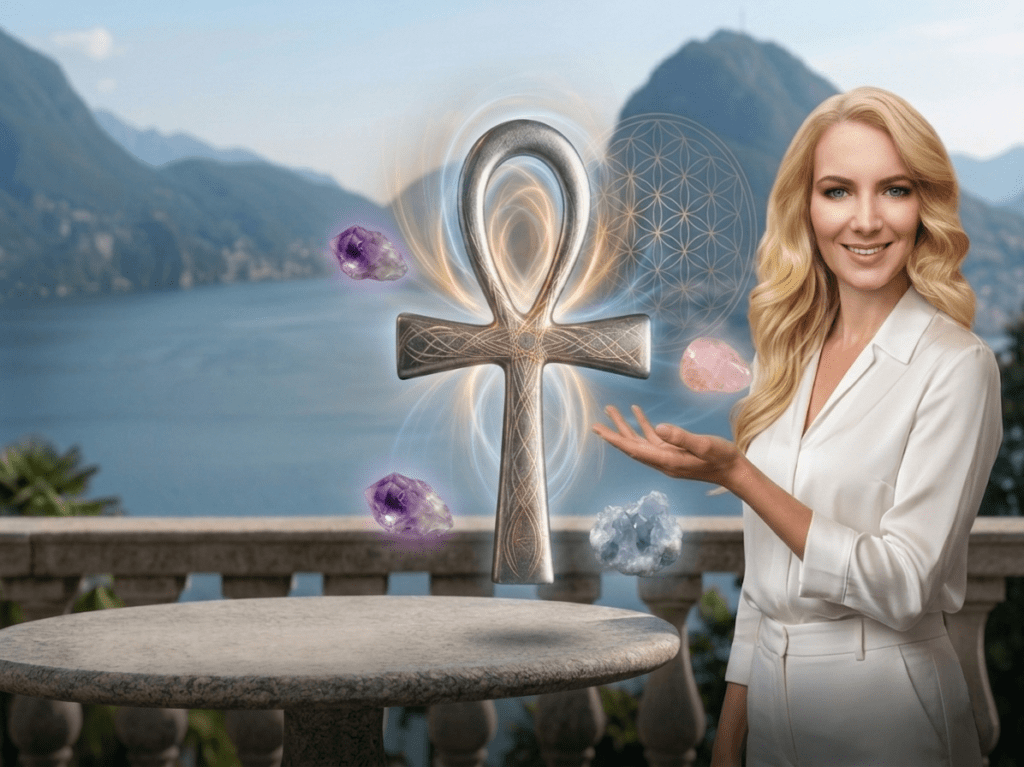
Here is a short ritual that uses the symbol honestly — as a focusing cue for a nervous-system reset:
- Sit comfortably and hold or picture the Ankh. Let the loop represent breath returning, the cross represent your body steadying.
- Breathe in for four counts, then out slowly for eight. The long exhale is what engages the vagus nerve and the calming branch of your nervous system.
- Repeat for three to five minutes. As you breathe, silently set one intention: not a dramatic transformation, just “steadier than yesterday.”
Research on intention suggests the quality of how you enter a practice — how present, deliberate and unhurried you are — meaningfully shapes how restorative it feels. The ritual is not magic; it is structured attention, and structured attention calms the body.
Takeaway you can use today: do the three-minute version once, now. A practice you complete beats a longer one you postpone.
How can you begin Egyptian-inspired energy healing from anywhere in the world?
Here is the part most articles leave out: you do not need to live near a practitioner to do this work. Because energy healing and the needle-free, frequency-based methods I use rely on intention, breath and the nervous system rather than physical touch, they translate fully to a video session — wherever you are, whatever your time zone.
A remote session looks like this: we meet by video, I take a structured intake (and, where relevant, a Traditional Chinese Medicine reading of your pattern), and I guide a needle-free, frequency- and breath-based treatment while you stay comfortable in your own home. Most people feel the shift toward calm within the session itself; deeper recovery builds over a few weeks. I work across international time zones specifically so that distance — Australia, the Americas, anywhere — is never the reason someone stays stuck.
Egyptian-inspired energy healing and needle-free, frequency-based TCM work can be delivered remotely by video, because they rely on intention, breath and nervous-system regulation rather than physical touch. Sessions are scheduled across international time zones, so you can begin from anywhere in the world — most people feel calmer within the first session, with deeper recovery over a few weeks.
This is the foundation of my ANKH CODE™ programme — a structured, remote-first path that turns the symbolism that brought you here into an actual nervous-system reset. For the deeper rationale on why this addresses the root of chronic stress rather than the surface, see From Overdrive to Inner Drive.
Takeaway you can use today: if distance has been your excuse, drop it. Book a short call and find out whether remote work fits you — before another month passes on overdrive.
Embracing Eternal Energy Through Holistic Wellness

The journey into the Ankh does not end with understanding the symbol. It moves into practice — into the direct experience of what becomes available when the biofield is coherent, the ancestral layer is cleared and life-force is circulating rather than leaking.
Revitalising Your Biofield
Your biofield is the electromagnetic and biophotonic field generated by every cell, organ and system in your body. It is not static. It responds to your environment, your emotional state, your history and the history of those you came from.
Most chronic depletion — the exhaustion that does not respond to rest, the anxiety that has no current trigger, the ceiling in performance that has no obvious cause — is biofield-level disruption, not tissue-level pathology. This is why conventional interventions, which address the body at the structural or biochemical level, often produce only partial resolution.
The Ankh works at the biofield level. So does Traditional Chinese Medicine, when practised at its depth. The concept of Jing — the ancestral essence stored in the Kidneys — maps precisely onto what epigenetics now documents as transgenerational inheritance: patterns from your lineage, encoded not in your DNA sequence but in its regulatory layer, shaping your expression before you had any say in the matter.
Revitalising the biofield, in this framework, is not about adding energy. It is about restoring the coherence and circulation of the energy already present — and clearing the inherited disruptions that fragment it.
Begin your reset — from anywhere
If the Ankh brought you here, let it do its real job: be the reminder that prompts you to act. The work that follows — calming an overdriven nervous system — is concrete, it is remote-friendly, and it can begin with one conversation.
👉 Explore the ANKH CODE™ programme · Book a remote session · Book a free 20-minute discovery call.
About the author. Jasmine Angelique is a Swiss-certified TCM practitioner and naturopath with over 7 years of clinical experience. She works worldwide via telemedicine, and in person in Barcelona, Milan, Lugano, London and Belgrade. She developed the APEX CODE Method™ and is the author of The Achievement Void and Light Medicine.
Frequently asked questions
What is the Ankh healing symbol? It is an ancient Egyptian hieroglyph meaning “life” — the “key of life” — later adopted in wellness as a symbol of restoration and balance. Today it functions as a focusing cue, not a treatment.
Is Egyptian quantum healing a medical treatment? No. There is no clear evidence supporting it as a medical treatment, and the word “quantum” is metaphorical. It is best framed as a symbolic, ritual-based wellness practice that can support calm and focus.
Does acupuncture help with stress and anxiety? Published meta-analyses suggest acupuncture can modestly reduce anxiety and improve sleep, with good safety, though study quality varies. It is best used as complementary care, not a replacement for medical or psychological treatment.
Can energy healing really work remotely, from another country? Yes. Because the work is needle-free and based on intention, breath and nervous-system regulation rather than touch, it is delivered by video and scheduled across time zones. You can take part from anywhere, including Australia and the Americas.
Can I combine this with conventional medical care? Yes — and you should. Energy healing and acupuncture are intended to sit alongside your medical or psychological care, never instead of it. If symptoms are severe or persistent, see your doctor.
Sources
- Ankh – ancient Egyptian symbol of life – https://en.wikipedia.org/wiki/Ankh
- Yang et al. (2021), Effectiveness of acupuncture on anxiety disorder: systematic review & meta-analysis (20 RCTs; SMD −0.41) – https://www.ncbi.nlm.nih.gov/pmc/articles/PMC7847562/
- Acupuncture vs sham for generalized anxiety disorder: meta-analysis of 14 RCTs (2025) – https://www.ncbi.nlm.nih.gov/pmc/articles/PMC12646924/
- NCCIH – Acupuncture: In Depth – https://www.nccih.nih.gov/health/acupuncture-in-depth
- NHS – Acupuncture – https://www.nhs.uk/conditions/acupuncture/
For information only. This article is not medical advice.