



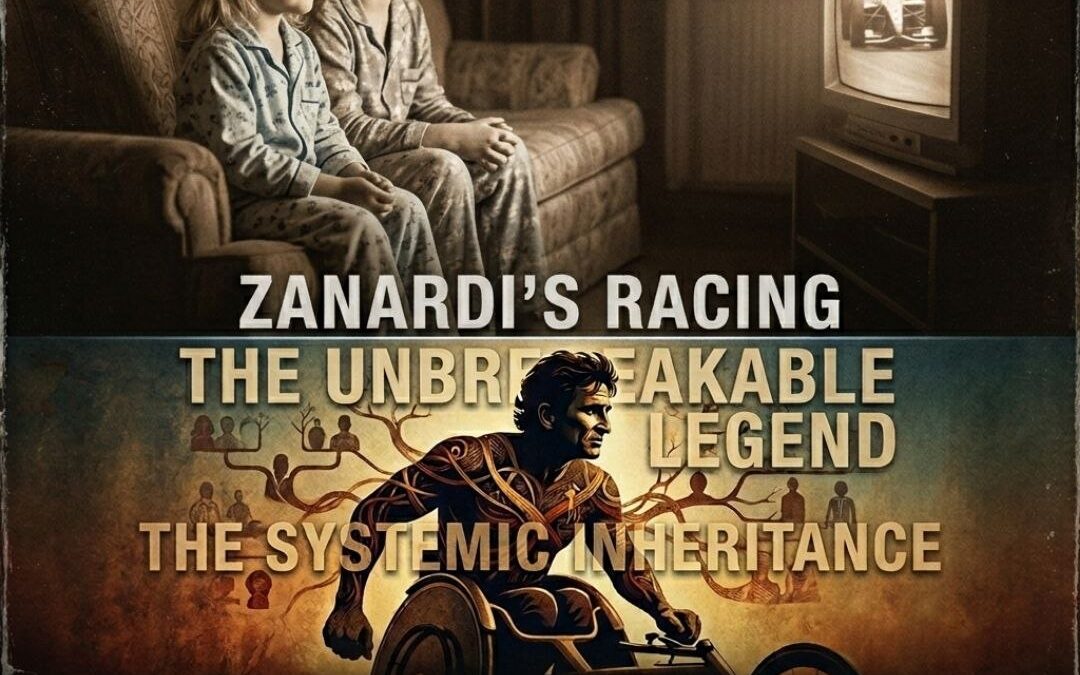
A systemic healing therapist’s personal tribute — and the uncomfortable truth the tributes are leaving out
By Jasmine Angelique
He died on May 1, 2026. The same day that claimed Ayrton Senna, thirty-two years earlier. As if even in death, the universe placed him beside another man who could not — or would not — stop.
I heard the news and something in me went very still.
Not just because Alex Zanardi was a public icon. But because of the midnight races.
The Midnight Races
When I was a child growing up in Switzerland, my brother would gently shake me awake in the dark. “Come on — Zanardi’s racing.” Half-asleep, I’d stumble to the television and we’d sit together in the blue glow, watching. Alex would start near the back of the field — sometimes dead last — and lap after lap, he would carve forward. One car, then another. That fearless precision. That refusal to stay where he’d been placed. I’d hold my breath until he broke through.
Those nights were not just about motorsport. They were my earliest education in will.
But today, watching the tributes pour in — hero, legend, unbreakable spirit — I find myself sitting with a different kind of feeling. Something quieter and more difficult than admiration. A practitioner’s recognition of a pattern I have seen many times in the therapeutic space. And a very human grief that goes beyond the loss of one man.
Alex Zanardi’s life was extraordinary. It was also, when read through the lens of Family Constellations and systemic healing, a story the family system had been trying to tell for a very long time.
The Family Behind the Champion
Alessandro Leone Zanardi was born on 23 October 1966 in Bologna, Italy, to Dino — a strict, hot-tempered plumber — and Anna, a quiet shirtmaker who woke at four in the morning to sew buttonholes by lamplight. They moved to the suburb of Castel Maggiore when Alex was three. There were two children: a daughter, Cristina, and a son, Alex.
Cristina was a promising competitive swimmer. She aspired to the Olympics.
In 1979, when Alex was thirteen and Cristina was fifteen, she died in a road accident.
Alex began kart racing that same year. He built his first kart from dustbin wheels and pipes from his father’s workshop.
This is the moment the family constellation practitioners call the opening movement. A system absorbs a sudden, violent death. An athlete’s future — Cristina’s Olympic dream — is severed mid-race. And a thirteen-year-old boy, now the only child, takes to the road. Not away from speed. Toward it. In the same year.
From a systemic perspective, this is not coincidence. It is not pathology either. It is loyalty — what Bert Hellinger called blind love: an unconscious movement toward a family member who could not complete their journey, carried forward by someone who can. Alex may have stepped into speed not only out of personal passion, but as a way of running the race his sister never finished. Her dream of athletic excellence, transferred and transmuted, finding new form in the roar of an engine.
His parents, predictably, became overprotective after Cristina’s death. Alex himself recalled it in a Guardian interview: “I was the crazy one, the wild one, and so after Cristina died my parents became very protective. They were very, very scared.” He raced anyway. Perhaps because some part of him understood, without words, that this was not merely his choice.
What Family Constellations Theory Tells Us
Bert Hellinger’s therapeutic method — Family Constellations — emerged from decades of work with thousands of families and was later developed and practised globally by licensed facilitators across clinical and transpersonal traditions. At its core, the theory holds that family systems operate according to invisible orders: every member must be included, seen, and granted their rightful place. When someone is excluded — through premature death, unspoken loss, unprocessed grief, or the simple human tendency to move forward without looking back — the system seeks to compensate. And it does so through the living.
Hellinger described this as systemic entanglement: the way present-day behaviours, patterns, even accidents and illnesses can be expressions of unresolved dynamics in previous generations. Ivan Boszormenyi-Nagy, whose work influenced Hellinger, called these invisible loyalties — forces more powerful than what we can consciously observe or learn, carried in the body, in choices, in the direction of a life.
The key principle is this: we do not escape our family system. We move within it, often without knowing. And when unresolved loss has not been named, held, and grieved properly, it finds its way into the stories of those who come after — sometimes as beauty, sometimes as tragedy, most often as both at once.
Cristina Zanardi died in a road collision. She was fifteen. An athlete who would never race. The family absorbed the blow in silence — as families of that generation often did. No constellation work. No family therapy. A father who grieved as men of his era were permitted to grieve: through work, through strictness, through control. A mother who sewed at four in the morning. And a boy who built a kart out of his father’s pipes and set out, at thirteen, to go as fast as the world would allow.
A Body Halved: September 15, 2001
Alex Zanardi had become a two-time CART champion, a beloved figure in American open-wheel racing, a man who spun victory donuts on circuits around the world and made grandstands erupt with joy. He had a wife, Daniela, whom he married in 1996. A son, Niccolò, born in 1998.
Then came Lausitzring.
On September 15, 2001, during a CART race in Germany, Zanardi’s car spun out of the pits and was struck at high speed by Alex Tagliani’s machine. The impact severed both of his legs. He lost nearly three-quarters of his blood volume. His heart stopped multiple times. Doctors gave him almost no chance of survival.
He survived.
And what followed is the part of the story the world celebrated most: the prosthetics, the return to motorsport with hand controls, the handcycling, the four Paralympic gold medals, the twelve UCI World Championship titles, the marathon victories. The image of a man who looked at what remained of his body and said: “I looked at the half that was left, not the half that was lost.”
It is a statement of breathtaking courage. It is also, systemically, worth pausing at.
Because the family system had just done something very specific: it had halved the body of the boy who had survived when his sister did not. A partial death. A crossing of the threshold that did not complete itself. And in response, Alex did what he had always done: he converted the loss into performance. He transformed the amputation into a launchpad.
For the world, this was inspiration. For the system, this was an incomplete answer.
In Family Constellations work, when someone transforms profound loss into triumph without first being fully present to the loss itself — without sitting inside the grief, inside the reduction, inside the stillness — the system tends not to close the account. It holds it open. And open accounts in family systems, as therapists like Hellinger and more recently Mark Wolynn (whose research on inherited trauma has been widely published) consistently find, tend to reopen — often with more force, often at a time when the person believes themselves to be safe.
The father, Dino, had died of cancer in his early fifties — another life cut short before its natural completion. Anna, already carrying the loss of her daughter, buried her husband. And Alex kept racing.
The Second Collision: June 2020
In June 2020, at fifty-three years old, Alex Zanardi was competing in the Obiettivo Tricolore — a charity handcycling relay across Italy. In Tuscany, on a downhill stretch near Pienza, he lost control of his handbike, crossed lanes, and collided head-on with a truck.
He suffered severe cranial and facial injuries. He underwent three hours of neurosurgery and was placed in an induced coma. He spent more than eighteen months in hospital before returning home. He spent the last six years of his life in a residential care facility near Padua, protected by the fierce, unwavering love of his wife Daniela and surrounded by privacy.
He died on May 1, 2026, at 59 years old. Peacefully, his family said. Surrounded by those he loved. The immediate cause — whether cardiac arrest, pneumonia, or the accumulated weight of six years of fragility — was not confirmed at the time of writing. His mother Anna, now in her eighties, received the news on a Friday evening. “At midday he was fine. By evening he was gone.”
Two road collisions. Two encounters with trucks and speed and the sudden violence of impact. And this time, no return.
I do not read this as cruelty. I read it as a system completing a sentence it had been writing for decades.
The Question the System Was Asking
In Family Constellations work, we speak of following — the unconscious identification with a family member who has gone before, who was excluded from the system’s grief, who has not been properly seen. Cristina Zanardi died in a road collision. She did not finish her athletic career. She was not yet given her gold medals.
Alex finished them for her. He ran the races she could not. He stood on podiums in her name, even if neither he nor anyone around him knew that was what he was doing.
And when the body was halved — the legs removed, the speed made literally impossible in its original form — the system invited him, for the first time, to stop. To sit with what had happened. To grieve not only his own body but the sister who had never been fully mourned. To ask: What am I running from? What am I running for? And is this drive to prove still mine — or does it also belong to someone I loved and lost?
Instead — heroically, magnificently, and perhaps fatally — he ran again. He built new legs from carbon fibre and titanium and pushed forward into a new frontier of achievement. The world cheered. The system waited.
I am not suggesting he should have lived differently. I am not diminishing a single gold medal or a single kilometre of a marathon. I am saying what I believe any systemic therapist looking at this constellation would say: the pattern was inviting integration, not acceleration.
When we cannot stop — when the drive to prove, to win, to demonstrate that pain has not broken us becomes the very air we breathe — we risk something essential. We risk missing the message that the loss was carrying. And in family systems, messages that are missed tend to be delivered again, more directly, until they are finally received.
Anna: The Woman Who Holds the System
In an interview with La Repubblica published days after Alex’s death, his mother Anna — over eighty years old, back in the family home at Castel Maggiore — spoke in few, exhausted words. “Alex was a wonderful boy, the absolute best. There is so much love left. The phone is full of messages from all over the world.”
And then: “I don’t know how I’ll manage now. It went like this.”
A woman who has buried a daughter, a husband who died too young, and now a son. Three losses. Three exits before their natural time. Three collisions with finality.
She has not been quoted as blaming God or fate or the universe. She has been quoted as saying, simply, that she doesn’t know how she’ll go on. This is the voice of a woman who has carried more than one person’s portion of grief. Who has been the container, the witness, the one who remains.
In any systemic reading, Anna is the one who holds the entire weight of unresolved loss in this family. She has survived everyone. She stands at the centre of a constellation that has repeatedly asked: Who will grieve properly? Who will sit with what has been lost, not convert it into a medal or a comeback story?
The answer, so far, is no one. Because the culture around Alex — and around family systems in general — rewards the fight back, the triumphant return, the chin raised at adversity. Not the quiet, interior work of grief.
The Wound Beneath the Triumph
I want to be very clear: Alex Zanardi was not broken. He was remarkable. His warmth, his humour, his generosity of spirit — reported by everyone who knew him — were real. He was not simply a system’s pawn. He was a full, complex human being who chose love and laughter and family alongside the racing.
And yet.
There is something worth naming, especially for those of us who work in the space where body, mind, and ancestral inheritance meet. The need to prove — to demonstrate worth through achievement, to show that tragedy has not won, to convert every wound into a trophy — is one of the most seductive and least examined forces in human life. It mimics courage so perfectly that we rarely question it.
But in the systemic view, the compulsive drive to overcome is often love wearing armour. It is devotion to the people who didn’t make it. It is the body’s way of saying: I will live fully enough for both of us. I will win the race you couldn’t finish. I will prove that what happened to our family did not defeat us.
And this is both beautiful and costly. Because while that drive burns, the stillness necessary for integration never quite arrives. The question — who am I when I am not winning? — goes unanswered. The grief, compressed into fuel, keeps the engine running. Until it can’t.
What Healing Might Have Looked Like
I say this not in judgment but in tenderness: what if, after Lausitzring, Alex had allowed himself a period of radical stillness? Not the stillness of defeat, but the stillness of genuine encounter with what had happened — with the loss of his legs, yes, but also with the older, deeper loss that his body may have been carrying all along. The fifteen-year-old girl who died in a road collision. The father who left too soon. The mother left to hold everything alone.
What if he had sat in a constellation — had allowed someone to represent his sister, to speak what the system had never spoken aloud — and had, for the first time, been present to the grief beneath the drive?
He might still have raced. He might still have won gold. But he would have raced from a different place: from wholeness, not from the unnamed wound. From the knowledge that Cristina had been seen, grieved, and released to her rightful place — not carried forward in the unconscious fidelity of her little brother’s legs.
We will never know. But those of us who work with these systems know the pattern. And we can name it, not to diminish those who live it, but to serve those who are living it now. Who are reading this and recognising their own momentum. Their own inability to stop. Their own compulsive need to prove that the accident, the loss, the wound did not win.
What His Stubbornness Gave the World — and What It Can Give You
Here is what I know to be true: Alex Zanardi’s refusal to stay down was not a mistake. It was his greatest gift.
His stubbornness — that raw, magnificent, almost irrational refusal to accept the position life had placed him in — is precisely what made millions of people believe they could rise too. Children with disabilities. Adults broken by illness. Athletes told their careers were over. Ordinary people in ordinary living rooms, watching a man with no legs cross the finish line, who quietly decided: if he can, so can I.
That is not nothing. That is everything.
The question I am sitting with — and the question I want to leave with you — is not whether to be stubborn. It is what to aim that stubbornness at.
Alex aimed his at the finish line. And he crossed it, again and again, in ways that redefined what a human body could do. That deserves every tribute it has received and then some. He was not a cautionary tale. He was a legend. He was proof that the human spirit does not negotiate with circumstance.
But imagine — just for a moment — what that same ferocity could look like turned inward. Aimed not at a podium but at the hard, unglamorous, deeply necessary work of healing a family wound. Of sitting across from a parent in conflict and refusing to walk away until something real is said. Of returning, stubbornly, to the grief you have been outrunning, not to be consumed by it but to integrate it — so that you race lighter. So that you race free.
This is what I wish for you. Not that you stop being stubborn. Not that you shrink your ambition or soften your drive. But that you take even a fraction of Alex’s relentless energy and aim it at the unresolved conversations in your family. At the parent you haven’t forgiven. At the sibling story that was never fully told. At the loss you transformed into momentum before you ever let yourself grieve it.
Because here is the paradox of systemic healing: when you do that work — when you face the wound instead of outrunning it — you don’t become less. You become more. You achieve from fullness rather than from the hollow hunger of the unprocessed past. Your victories stop costing you what they shouldn’t cost. And the people around you, the Niccolòs and the Annas in your own life, stop quietly paying the price of your unfinished story.
Goodbye, Legend
Alex Zanardi died on May 1, 2026. The same day as Senna. As if the universe wanted to be sure we understood the magnitude of what we had lost.
He was fifty-nine years old. He had won races most of us cannot imagine entering. He had rebuilt a life from rubble not once but twice, with a smile that could light a grandstand and a warmth that everyone who met him remembered. He was a husband, a father, a son, a friend, and one of the most luminous human beings his sport has ever produced.
My brother woke me up at midnight to watch him race. I am glad he did. Those nights shaped something in me — a bone-deep belief that where you start doesn’t determine where you finish. That you carve forward, one position at a time, even when the field looks impossible.
I carry that with me still. And now, as a healer, I carry something else too: the belief that the bravest race any of us will ever run is not on a circuit, but inside ourselves. In the quiet. In the difficult conversations. In the willingness to stop — just long enough to feel what we have been outrunning — and then to rise again, fully, from a place the wound can no longer reach.
Thank you, Alex, for the midnight races. For the spin donuts and the gold medals and the proof that the human spirit is simply not for sale. Go rest now. You have more than earned it.
Goodbye, legend. The grid will never look the same.
Jasmine Angelique is a licensed TCM practitioner, naturopath, and systemic wellness therapist working across Europe and via telemedicine worldwide. She is the founder of the APEX CODE Method™ and the author of Medicina de Luz and The Achievement Void. She works with high-achievers navigating burnout, somatic trauma, and ancestral patterns at the intersection of Eastern medicine and systemic healing.
→ Book an in-person session in Barcelona: acubarcelona.com → Work with Jasmine online via the APEX CODE Method™: medicinacinese.ch → 20-minute discovery call: Book here → Follow on Instagram: @energyangel.nft