



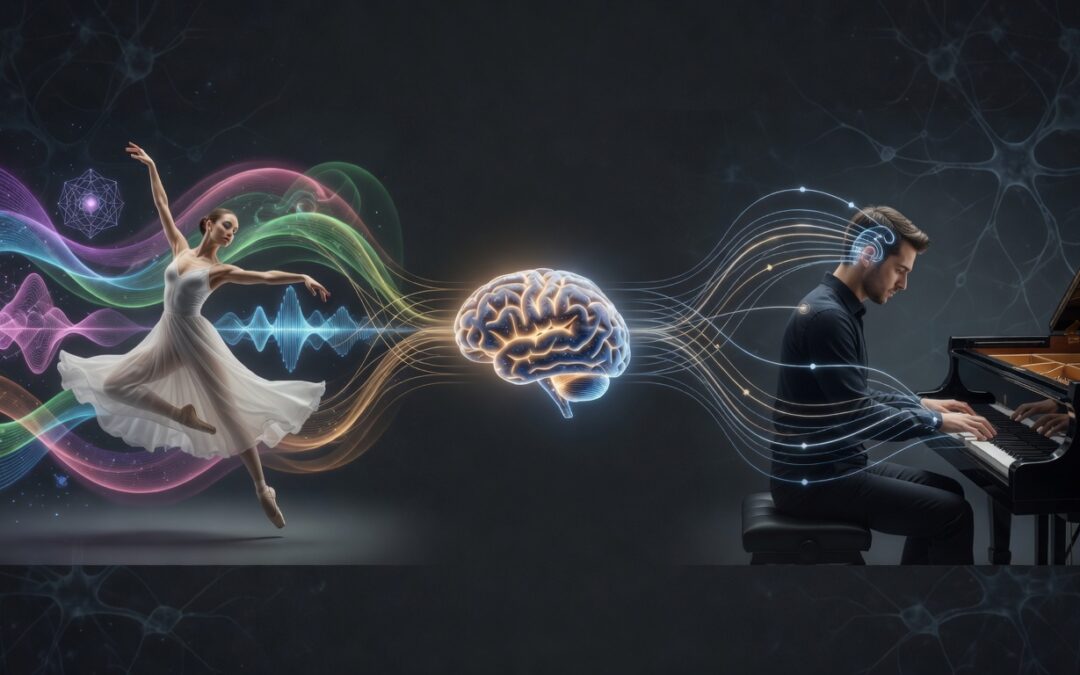
Neuroplasticity Comparison: Dancers vs. Musicians
(Updated to 2026)
Both dance and music training are powerful drivers of neuroplasticity — the brain’s ability to reorganize its structure and function in response to experience. They produce overlapping changes (especially in multisensory and sensorimotor integration) but also distinct adaptations shaped by the demands of each activity: whole-body, multimodal coordination + emotional expression in dance versus precise auditory-motor control + fine motor dexterity in music. Here’s a side-by-side breakdown based on key neuroimaging studies (fMRI, EEG, DTI, structural MRI) up to 2026.
1. Shared Plasticity Effects
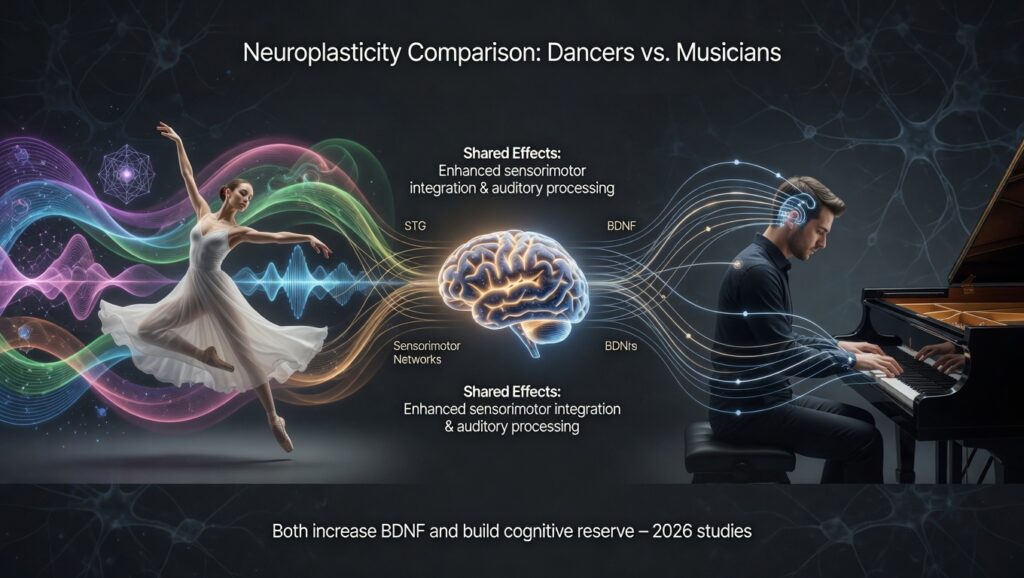
- Superior temporal gyrus (STG) and auditory regions: Both dancers and musicians show increased cortical thickness and gray matter volume compared to non-experts. This area supports rhythm, melody, and auditory processing. Better performance on dance imitation, rhythm synchronization, and melody tasks correlates with these changes.
- Sensorimotor integration: Enhanced connectivity and efficiency in premotor, parietal, and basal ganglia networks. Both groups exhibit stronger action observation network (AON) activation when watching familiar movements or listening to music.
- Hippocampal and memory-related areas: Dance often shows clearer benefits for hippocampal volume and memory (especially in aging or clinical populations), while music strongly boosts auditory memory and executive function.
- Overall neuroplastic potential: Both activities increase neurotrophic factors (e.g., BDNF), promote synaptic remodeling, and build cognitive reserve. They outperform many other interventions for motor-cognitive integration and emotional regulation.
2. Distinct Structural Differences (White Matter & Gray Matter)
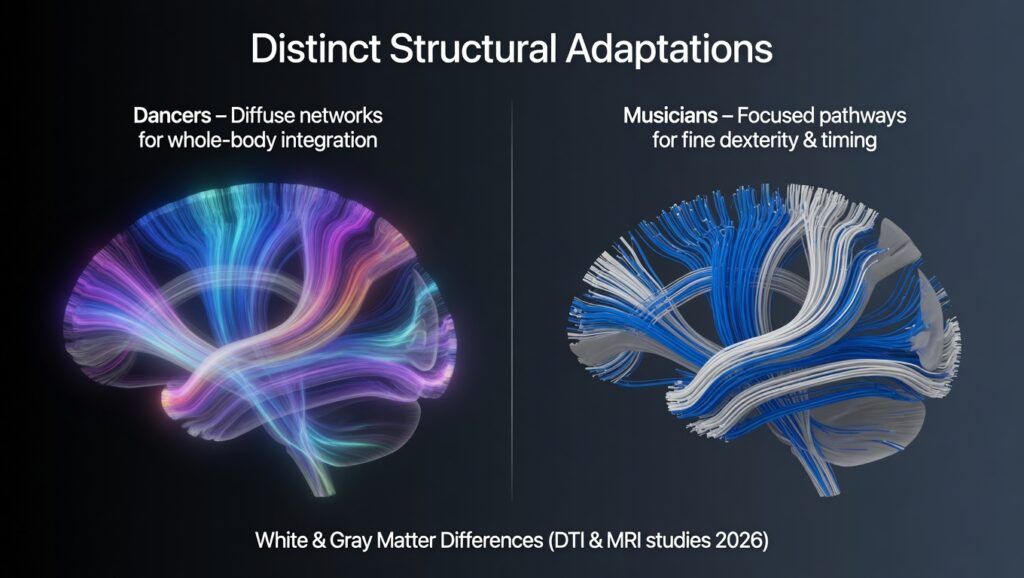
- White matter organization (key differentiator):
- Dancers: Reduced fractional anisotropy (FA) and increased diffusivity in the corticospinal tract, superior longitudinal fasciculus, and corpus callosum. This suggests greater fiber fanning, crossing, or larger axon diameter — optimized for whole-body coordination, integrating auditory + visual + proprioceptive + motor information across large muscle groups.
- Musicians: Increased FA and higher fiber coherence, especially in tracts supporting fine motor control (hands/fingers) and auditory-motor loops. This reflects more focused, efficient pathways for precise timing and dexterity.
- Gray matter and cortical thickness: - Both groups show increases in superior temporal regions.
- Musicians: Often larger gray matter volumes in auditory cortex, inferior frontal gyri (executive functions, syntax), hippocampus, and primary somatosensory cortex (hand-specific). Stronger structural covariance in auditory and default mode/somatomotor networks.
- Dancers: More pronounced changes in visual-kinesthetic and multisensory areas (e.g., occipitotemporal regions for body motion). Structural decoupling in left dorsolateral prefrontal cortex (DLPFC) linked to better dance-specific performance — suggesting local training effects dominate over global ones.
- Corpus callosum: Both show changes supporting interhemispheric communication, but dancers emphasize whole-body integration while musicians focus on bimanual coordination.
3. Functional & Oscillatory Differences (EEG & fMRI)
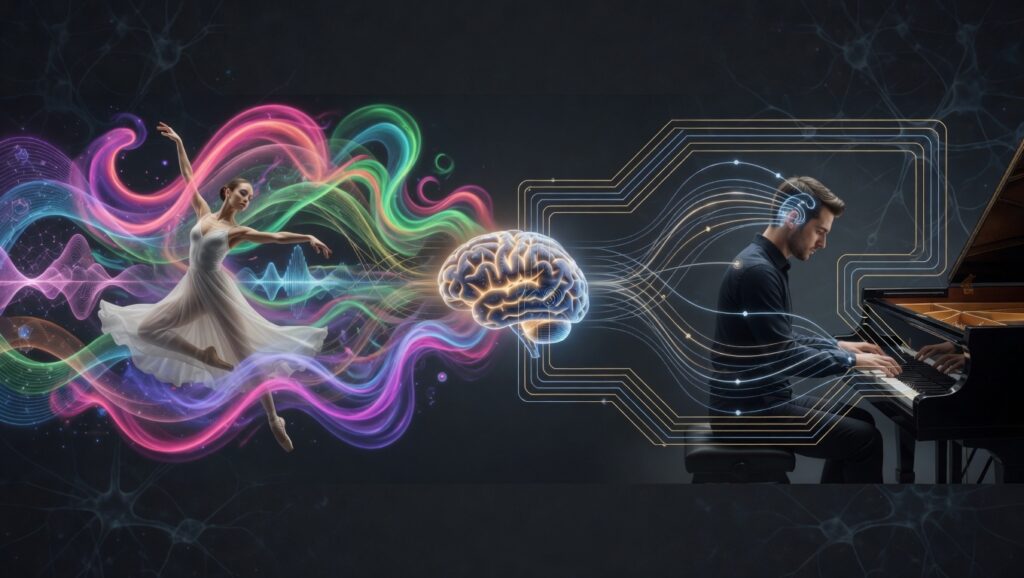
- Response to music and rhythm (Poikonen et al. studies):
- Dancers: Stronger theta (4–8 Hz) and gamma synchrony when music is present (vs. silence). Faster, reflexive brain responses to sudden musical changes (even before conscious awareness). Enhanced early auditory processing (P50) for timbre/brightness shifts. Theta links to emotion, memory, and multisensory integration — ideal for expressive, whole-body movement to music.
- Musicians: Decreased alpha and beta synchrony with music (more precise, focused auditory processing). Stronger activations in auditory-motor and frontal areas during passive listening or performance. Better at syntax and pitch processing.
- Action observation and performance:
- Dancers show greater occipitotemporal sensitivity to bodily kinematics and stronger AON functional connectivity when watching dance.
- Musicians exhibit more extended activations in temporal, frontal (Broca’s area for syntax), and motor preparation regions during music tasks.
- Dynamic connectivity:
Musicians often show more frequent transitions between auditory-motor, limbic-frontal, and reward networks during music listening. Dancers emphasize visual-kinesthetic and emotional-memory networks.
Hanna Poikonen’s EEG Studies on Dancers’ Brains (2016–2024)
Hanna Poikonen (University of Helsinki, Cognitive Brain Research Unit) has pioneered naturalistic EEG methods to study real-world artistic stimuli like continuous music and dance — moving beyond short, artificial lab clips to long excerpts of actual performances. Her work compares professional dancers, professional musicians, and laymen (non-experts) to reveal how expertise shapes cortical phase synchrony (how different brain regions coordinate their timing) and early sensory processing. Her research is groundbreaking because it uses long, continuous, ecologically valid stimuli (real dance pieces) and measures both event-related potentials (ERPs) for fast changes and phase synchrony for longer-scale brain communication. Below is a focused breakdown of the key studies, with emphasis on the 2018 phase-synchrony work that directly highlights dancers’ unique theta/gamma responses.
1. The Landmark 2018 PLOS One Study: “Naturalistic Music and Dance – Cortical Phase Synchrony in Musicians and Dancers”
Naturalistic music and dance: Cortical phase synchrony in musicians and dancers during naturalistic music and dance observation (Poikonen et al., 2018, PLOS ONE).
Why it matters: This is the study most often cited for the theta/gamma findings I mentioned earlier. It directly compares how music “activates” the brains of dancers versus musicians when watching dance.
Participants (18 per group after exclusions): - Professional dancers (ballet, contemporary, street dance). - Professional musicians (various instruments). - Laymen (no professional training in either).
All healthy, similar age (~25–29 years).
Stimuli: Long excerpts (15–63 seconds each, total ~15 min) from the contemporary dance piece *Carmen* (Mats Ek choreography, based on Bizet-Shchedrin music). Presented in four conditions:
- Music only (no dance). - Silent dance (low or high movement acceleration, measured via motion capture). - Full audiovisual (music + dance).
EEG Method: 128-channel EEG. They analyzed phase synchrony (using Hilbert transform and Shannon entropy on phase differences) across 66 electrode pairs in four frequency bands: theta (4–8 Hz), alpha (8–13 Hz), beta (13–30 Hz), and gamma (30–48 Hz). Data segmented into 5-second epochs.
Key Results (statistically significant after corrections): | Frequency Band | Dancers | Musicians | Laymen | |---------------|---------|-----------|--------|
| Theta (4–8 Hz) | Stronger synchrony with Music ON (many fronto-central & parieto-occipital pairs) | No effect | Some Music ON increase + dance interactions | | Gamma (30–48 Hz) | Stronger synchrony with Music ON | No effect | Some Music ON increase | | Alpha (8–13 Hz) | No effect | Decreased synchrony with Music ON | Dance-related decreases | | Beta (13–30 Hz) | Some Music ON increase | Decreased synchrony with Music ON | Dance × Music interactions |
What this means:
- Dancers’ brains show enhanced theta and gamma synchrony specifically when music is present. Theta is linked to multisensory integration, emotion, memory, and motor imagery. Gamma supports higher-level binding of perception and action. Music acts as a powerful “glue” that coordinates their brains more strongly — exactly what you’d expect from experts who constantly entrain whole-body movement to rhythm.
- Musicians’ brains do the opposite in alpha and beta: music reduces synchrony. This reflects their training for precise, focused auditory processing (less need for broad integration when sound is the main input).
- Laymen showed more scattered effects tied to the dance movements themselves.
Conclusions from the paper:
Expertise shapes how the brain handles multimodal (music + movement) stimuli. Dancers’ enhanced theta/gamma suggests superior multisensory and emotional-motor coupling. The authors note this could be useful for therapy, education, and understanding brain plasticity in the arts.
B. The Companion 2018 European Journal of Neuroscience Study (“Dance on Cortex”)
This earlier video-based version (same team) found enhanced fronto-central theta synchrony in dancers specifically when watching a contemporary dance piece — again linking theta to expertise-driven motor imagery and emotional processing.
C. The 2016 Scientific Reports ERP Study: Early Auditory Processing
Early auditory processing in musicians and dancers during a contemporary dance piece.
Key finding: Dancers showed a significantly enhanced preattentive P50 response to sudden increases in timbral brightness (a musical feature often paired with big movement changes in dance). This happens even before conscious awareness — dancers’ brains are “tuned” to detect sound changes that cue movement. When music was paired with dance choreography, N100 and P200 responses were suppressed and sped up in all groups, but the P50 boost was dancer-specific.
D. The Newest 2024 Study: Live Dance Audience (European Journal of Neuroscience)
Cortical oscillations are modified by expertise in dance and music: Evidence from live dance audience.
Setting: Real theatre — audience watched a live contemporary/breakdance duet (Un último recuerdo by Iron Skulls Co.). Findings: - Experienced dancers showed stronger fronto-central and parieto-occipital theta (4–8 Hz) phase synchrony than novices while watching the live performance.
- Musicians showed stronger delta (even slower waves) synchrony in some conditions. - Real-world live performance activated brains more than lab videos.
Poikonen’s quote: “If we have practised our bodily skills, we may better understand the body language of others, which makes social interaction smoother.” She emphasizes that live, embodied experiences create unique brain effects that virtual settings can’t replicate.
Overall Takeaways Across Poikonen’s Work
- Dancers’ signature pattern: Boosted theta + gamma synchrony with music → superior multisensory integration, emotional-motor coupling, and predictive processing of rhythm + movement.
- Musicians’ signature pattern: Reduced alpha + beta synchrony with music → more efficient, focused auditory processing. - These differences emerge even when participants are just watching/listening, not performing — showing deep, long-term plasticity from training.
- Practical implications: Explains why dance-to-music training is so powerful for neuroplasticity, why dancers may recover differently from athletes/musicians, and why therapies like dance movement therapy work so well for Parkinson’s, aging, and emotional regulation.
Poikonen’s methods (naturalistic stimuli + phase synchrony) are now a gold standard in the neuroscience of the arts. Her work beautifully shows that dancers don’t just “move to music” — their brains literally re-wire to integrate it at a deeper oscillatory level.
4. Behavioral & Practical Implications
- Dancers’ brains: Optimized for multimodal, whole-body prediction and emotional embodiment. Faster adaptation to changing rhythms, better integration of vision + sound + movement + emotion. This makes dance particularly powerful for balance, spatial navigation, social synchrony (inter-brain coupling in partner/group dance), and therapeutic applications (e.g., Parkinson’s, aging, hippocampal health).
- Musicians’ brains: Optimized for precise auditory-motor mapping and cognitive control. Superior fine timing, auditory memory, and executive function. Music training excels for language processing, attention, and fine motor recovery.
- Overlap & complementarity: Both build robust sensorimotor and reward networks. Combining elements (e.g., dance to music) may yield additive plasticity benefits.
5. Limitations & Notes
- Many studies involve professional or long-term trained individuals — causality can be bidirectional (training shapes brain; pre-existing traits may influence who persists).
- Sample biases: More female ballet/contemporary dancers in some studies; musicians often piano/string players.
- Dance tends to engage more aerobic + social + expressive elements, which may explain stronger hippocampal and emotional effects in some comparisons.
Musicians develop highly efficient, coherent pathways for auditory-fine motor precision. Dancers develop more diffuse, integrative networks for whole-body, multisensory, emotionally rich coordination.
Both demonstrate remarkable experience-dependent plasticity, but the “wiring” reflects the unique demands of each art form — focused dexterity vs. holistic embodiment.
This explains why targeted recovery practices (like acupuncture for athletes/dancers) can support the specific neural adaptations each group has built.
In my spare time I love to dance. I also took classes in salsa in the past and recently I have taken a class in ballet with www.kitri.ch and I would recommend her to everyone.