



And why choosing division over connection is the most expensive decision any leader makes today.
Jasmine Angelique · Traditional Chinese Medicine & Integrative Wellbeing
This morning, as you scroll your feed, three things are happening simultaneously.
In the Strait of Hormuz, US warships are attempting to guide stranded vessels through a war zone — over 20,000 seafarers trapped for months, global energy markets holding their breath. In New York and Los Angeles, tens of thousands marched this week under a banner of division: workers against billionaires, class against class. In London, the Dickens festival opened with a line that could not be more apt for 2026: ‘It was the best of times, it was the worst of times.’
And in Australia — a nation that just re-elected a government on a platform of looking after each other, not mimicking the politics of conflict — a quiet different signal is broadcasting.
Every crisis you are witnessing right now is, at its core, a crisis of disconnection.
The geopolitical. The economic. The social. The personal.
And the research is now unambiguous: the answer — biologically, neurologically, strategically — is not to take sides. It is to build connection.
The Strait of Hormuz and the CEO’s Bloodstream

What does an oil chokepoint have to do with your health?
Everything.
Since February 28, about 20% of the world’s seaborne oil and 20% of its liquefied natural gas has been blocked from flowing through the Strait of Hormuz. Supply chains fractured. Fuel prices surged. Some 800 vessels sit stranded in the Persian Gulf. Today, the US launched ‘Project Freedom’ — guided-missile destroyers, 100+ aircraft, 15,000 personnel — in an attempt to restore passage. Iran has already responded with missile fire.
Meanwhile: your cortisol response to reading this is identical to your cortisol response when you feel cut off from your team, your peers, or your family.
The brain does not distinguish between a blocked shipping lane and a blocked relationship. Both activate the same threat circuitry. Both deplete the same hormonal reserves. Both erode the same decision-making capacity.
Chronic disconnection is not a feeling. It is a physiological state — and it is costing your organisation more than you think.
Tracy Brower, sociologist and Vice President of Workplace Insights at Steelcase, published research that has been cited by McKinsey: lonely individuals show measurably reduced cognitive function, slower learning, and compromised decision-making. Loneliness activates the same neural pathways as addiction cravings — and social pain registers in the exact same brain regions as physical pain.
The leaders reading this right now — CEOs, founders, directors, general managers — are not immune. Senior professionals are among the loneliest people in the modern workforce. The higher the position, the fewer genuine peers. The greater the responsibility, the fewer safe spaces to be uncertain, human, or unoptimised.
New York Is Shouting. What It’s Actually Saying.
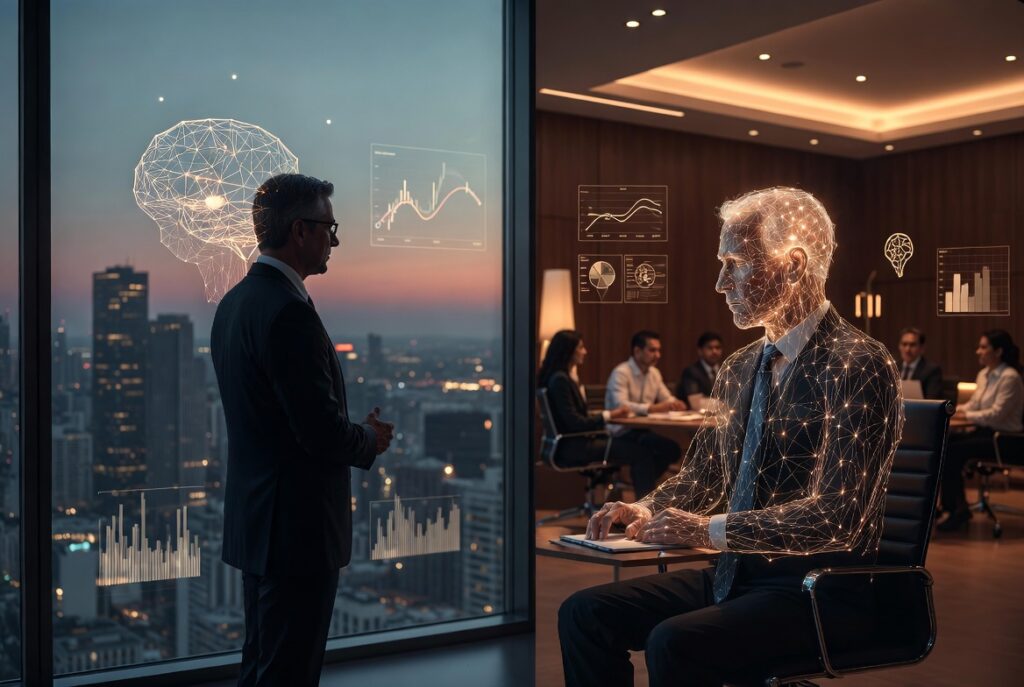
Hundreds of thousands marched in New York this week under the banner ‘Workers Over Billionaires.’ Demonstrations blocked Wall Street. Protesters marched to Amazon’s Midtown offices. The city’s new democratic socialist mayor released a video in solidarity.
This is not primarily a political story. It is a disconnection story.
When people feel unseen, unheard, and economically irrelevant, they do not retreat into silence. They organise around opposition — because opposition is the only form of connection still available to them. The protest is not the problem. The protest is the symptom.
For the founders and executives reading this: the people marching are not your enemy. They are the canary. They are telling you what happens when organisations — and societies — treat efficiency as the only metric worth measuring.
You cannot build a high-performance culture on people who are quietly, chronically, professionally alone.
Research shows that employees in genuine community with each other make better decisions, learn faster, and perform under pressure with greater resilience. Not because of team-building exercises. Because the brain is structurally optimised for cooperative performance — and is measurably compromised when that connection is absent.
Australia Voted for Something. Did You Notice?

In May 2025, Australia re-elected Anthony Albanese in a historic landslide — the largest Labor majority in the nation’s history. The victory speech, delivered against a backdrop of global chaos, contained one line that deserves more attention than it received:
‘Australians have chosen to face global challenges the Australian way, looking after each other while building for the future.’
Not looking away from each other. Not competing against each other. Looking after each other.
One year on, with fuel shortages from the Hormuz crisis hitting hard and energy prices rising, Australian polling shows the population remains fractured — but the cultural instinct toward collective care is still the political centre of gravity. One Nation surges, but Labor holds. The reason, analysts suggest: in uncertain times, people gravitate toward leaders who make them feel less alone.
In uncertain times, people do not want more certainty. They want more connection.
This is not sentiment. It is neuroscience. Tracy Brower’s research shows that the brain performs better — smarter decisions, faster learning, greater emotional regulation — when people feel connected to others who are affected by their choices.
The implication for any leader, in any industry, in any of the cities you operate in: your performance infrastructure depends on your connection infrastructure.
London, Dickens, and the Cost of Choosing Sides
This weekend in London — a city home to more LinkedIn professionals per square mile than almost anywhere on the planet — the Fleet Street Festival of Words opened with Dickens: ‘It was the best of times, it was the worst of times, it was the age of wisdom, it was the age of foolishness.’
The festival’s theme for 2026: ‘Words that explore the age of wisdom and foolishness.’
We are, right now, genuinely living both. The technology to connect any two humans on earth in real time exists. And yet the loneliness epidemic is classified by the WHO alongside obesity and smoking as a primary health risk. The UK government has had a Minister for Loneliness since 2018. Brower describes the mechanism with devastating simplicity:
We have elevated convenience above connection. Every frictionless app, every virtual meeting, every food delivery that replaced a conversation — the efficiency we gained came at a biological cost.
For the executives and senior directors navigating London’s financial district this week — cost-of-living pressures, geopolitical market volatility, teams exhausted from three years of hybrid uncertainty — this is not a soft skills conversation. It is a performance conversation.
Disconnected leaders make worse decisions under pressure. Disconnected teams underperform in precisely the moments they need to excel. And disconnected organisations — regardless of revenue — are structurally fragile.
What the Science Says You Actually Need
The research is more specific than ‘connect more.’ Here is what the evidence shows actually works, expressed as a framework for anyone who operates at leadership level:
- Quality over quantity. Deep friendships — characterised by authentic vulnerability, mutual responsiveness, and genuine investment — improve cognitive performance, emotional regulation, and longevity. The number of contacts in your LinkedIn network is irrelevant to this equation.
- Sixty hours of investment. Studies suggest genuine friendship requires approximately 60 hours of shared time to form. Not 60 meetings. Not 60 messages. Sixty hours of presence. Most senior professionals have not spent 60 hours in non-transactional conversation with any peer in the last year.
- Perceived partner responsiveness. The single most reliable predictor of whether someone feels genuinely connected to you is not what you say — it is whether they feel understood, validated, and supported by the interaction. This is a skill. It can be developed.
- Self-awareness as a leadership competency. People trust predictability. The leaders who build the strongest relational equity are not the most charismatic — they are the most legible. Consistent. Readable. Safe to be honest with.
- Balancing advocacy with inquiry. High-performing leaders speak and listen in equal measure. Most do not. The higher the position, the greater the tendency toward advocacy over curiosity. This is the precise pattern that erodes the relational trust that performance depends on.
The research is clear: you will make better decisions and recover faster from setbacks when you are genuinely connected to the people around you.
Owning Your Power to Create Peace
Here is what every headline from today — Hormuz, New York, London, Melbourne, Chicago, Los Angeles — has in common.
They all show us what happens when human beings organise around division instead of around connection. When the dominant operating principle becomes ‘who is against whom’ rather than ‘what are we building together.’
And every single one of those headlines is downstream of a personal daily choice that each of us makes — in our organisations, our families, our bodies, our nervous systems.
The choice to eliminate friction instead of cultivating connection.
The choice to be efficient instead of present.
The choice to manage people instead of seeing them.
You cannot build peace in the world from a nervous system that has abandoned itself.
Traditional Chinese Medicine has understood this for three thousand years. The organ systems do not function in isolation — they function in relationship. The Liver governs the free flow of Qi throughout the body. When that flow is suppressed — by stress, isolation, chronic overperformance, or the constant low-grade threat of disconnection — it does not stay local. It affects sleep. Digestion. Immunity. Emotional regulation. Decision-making clarity.
The body is not a machine that can be optimised in parts. It is a system held in coherence by connection — internal and external.
What the neuroscience is now confirming, TCM has always mapped: isolation is not a state of rest. It is a state of disruption. And the remedy is not relaxation. It is reconnection.
Three Shifts That Cost Nothing and Return Everything
These are not wellness tips. They are strategic reorientations for leaders who operate in the world as it actually is today.
- Replace ‘I have to’ with ‘I get to.’ This single linguistic shift — applied to the people in your professional and personal life — has measurable downstream effects on cortisol levels, relational quality, and decision-making energy. The research on language and physiology is not metaphorical.
- Audit where you have replaced connection with convenience. Not to reintroduce inefficiency for its own sake, but to identify which frictionless shortcuts have removed the relational moments that your brain and your team genuinely depend on.
- Invest time in one relationship that currently receives none. Sixty hours to build genuine connection. Start with one conversation this week that has no agenda, no deliverable, and no end time. Not a networking call. A human conversation.
The world is not going to become less complex before you feel ready to address your wellbeing. The Strait of Hormuz will not resolve before your cortisol levels require attention. The politics of division will not quieten before your nervous system needs restoration.
The moment to choose connection over division is not when the world becomes peaceful. The moment is now. And the territory where that choice begins is always the same: inside you.
If something in this resonated:
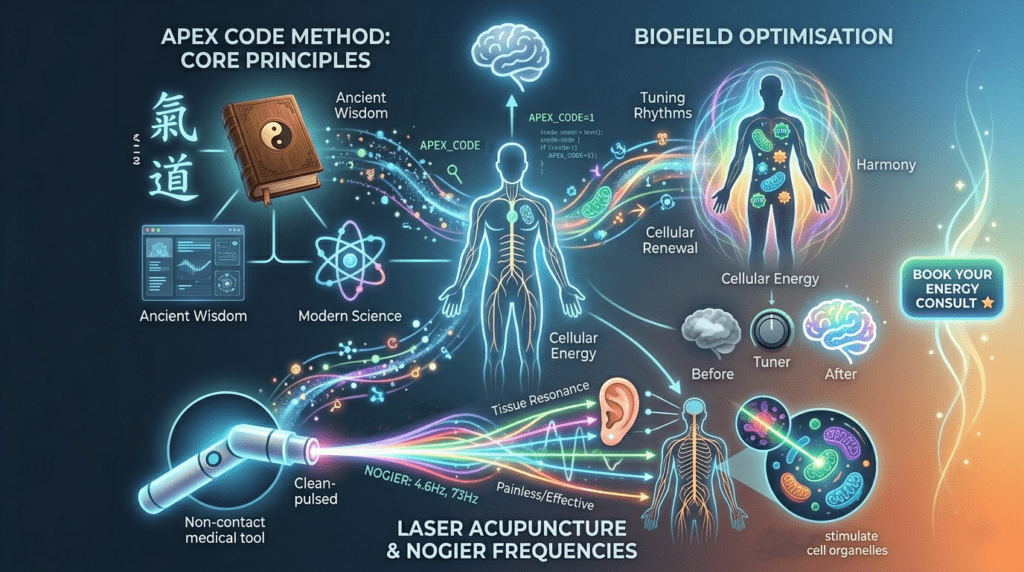
The work I do integrates Traditional Chinese Medicine, laser acupuncture, and the APEX CODE Method™ — a precision wellbeing framework developed specifically for high-performing individuals who cannot afford to operate at less than full capacity. Clients include surgeons, founders, executives and professional athletes across Barcelona, London, Milan, Lugano, Belgrade, and worldwide via telemedicine.
If what you have read here suggests your performance infrastructure deserves a closer look, the next step is a 20-minute conversation — no obligation, no sales process. Just clarity.
→ Book a free 20-minute discovery call: click here
→ In-person Barcelona: Book here
→ Telemedicine / APEX CODE Method™: Book here
Jasmine Angelique
Specialist, Traditional Chinese Medicine & Integrative Performance Health
medicinacinese.ch · Instagram: @energyangel.nft
Barcelona · London · Milan · Lugano · Belgrade · Worldwide via Telemedicine