


Quick Summary: You can calm down in under five minutes without meditating by lengthening your exhale, releasing tension, pressing the Yintang or Shenmen acupressure points, cooling your face with cold water, and moving your body. Writing down the stressor and one next action can stop anxious thoughts from circling, while practicing the routine when calm makes it easier to use under pressure. If stress persists for weeks or disrupts sleep, professional support such as acupuncture and TCM care may be needed for longer-term relief.
Ten minutes before a board presentation or an Olympic trial, the fastest stress relief techniques do not involve watching your breath. You calm down without meditating by pressing an acupressure point, lengthening your exhale and moving your body. This guide gives you nine relaxation methods in a timed four-phase protocol, built on traditional Chinese medicine principles that help executives and athletes recover fast.
Step 1: Arrive in Your Body in the First Two Minutes
Lengthen the Exhale Instead of Trying to Empty Your Head
You can calm down without meditating by changing how you breathe. When stress spikes, your exhale is shorter than your inhale. Flip that. Stanford researchers found that exhale-focused “cyclic sighing” lowers anxiety better than most relaxation methods. Take a double inhale through the nose, then one slow exhale through the mouth. Repeat five times. The longest exhale acts as a brake on the fight-or-flight response, so this works as one of the fastest anxiety reduction tips you can use between meetings.
Dump the Tension You Are Holding in Your Jaw, Shoulders and Hands
Stress hides in three places: your jaw, shoulders and hands. Unclench your teeth, drop your shoulders and open your fingers for five seconds. Then squeeze and release each area once. This mini version of progressive muscle relaxation gives your brain physical proof that the threat has passed. It pairs well with gentle self-massage along the neck and shoulders, a relaxation method rooted in traditional Chinese medicine bodywork that is easy to learn at home.
Step 2: Use TCM Acupressure to Calm the Nervous System
Two points carry most of the evidence for stress relief: Yintang and Shenmen. Both appear together in a systematic review of acupressure on anxiety, and each works in under two minutes.
Press the Midpoint Between Your Eyebrows
The acupressure point Yintang sits between the eyebrows. Press it gently with one fingertip for 60 to 90 seconds while breathing slowly. Many people feel a soft release, as if the forehead lets go of a frown it did not know it held.
Shenmen (HT7): Work the Inner Wrist Crease
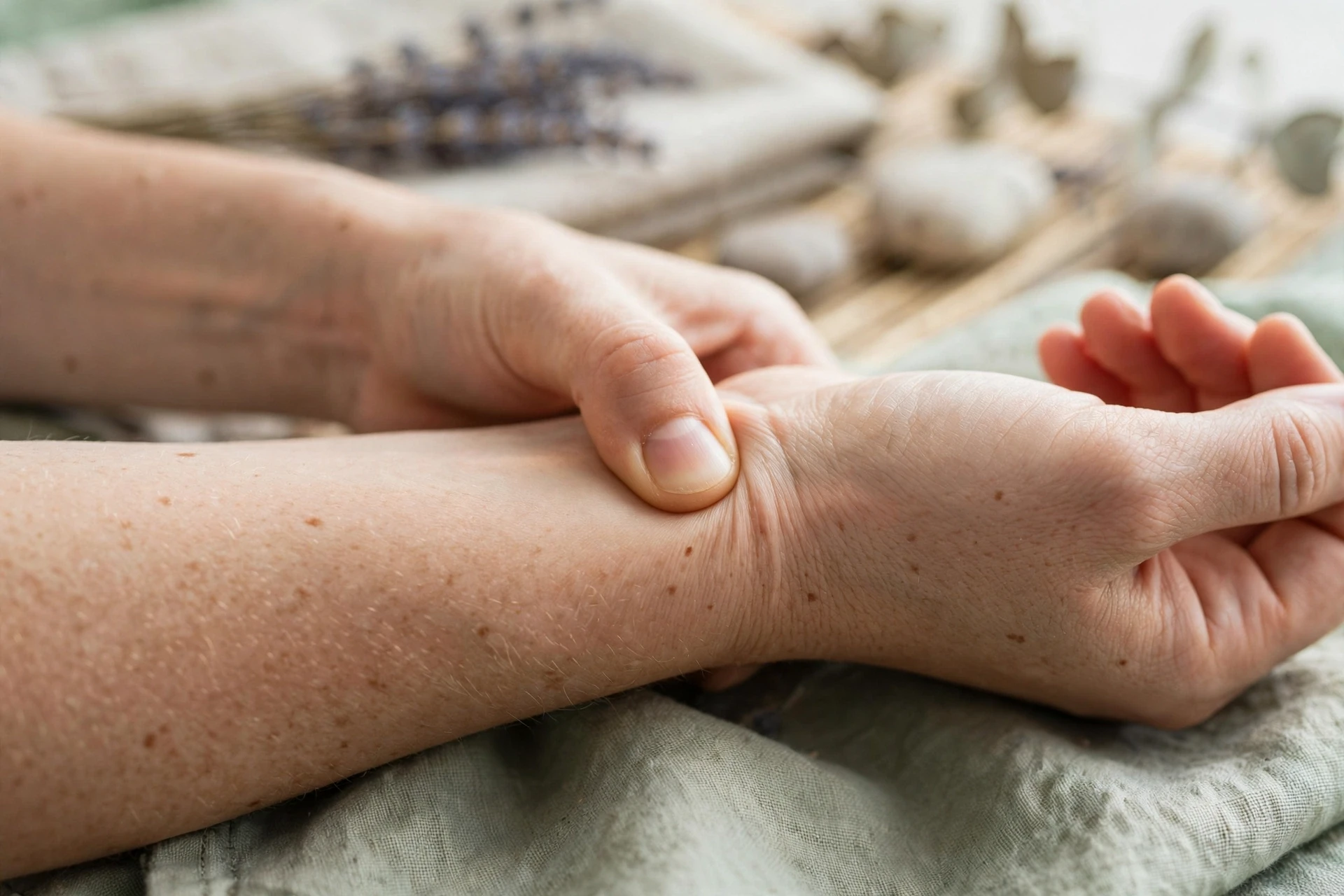
Shenmen, the “Spirit Gate,” lies on the pinky-side crease of your inner wrist. Press with your thumb, firm but not painful, for one minute per side. In traditional Chinese medicine, this point settles the spirit; research on HT7 stimulation shows it lowers stress hormones. A practitioner of acupuncture for stress can treat these same points with needles for deeper effect.
Step 3: Shift Your Focus in the Next Three Minutes
Cool Water on Your Face and Wrists
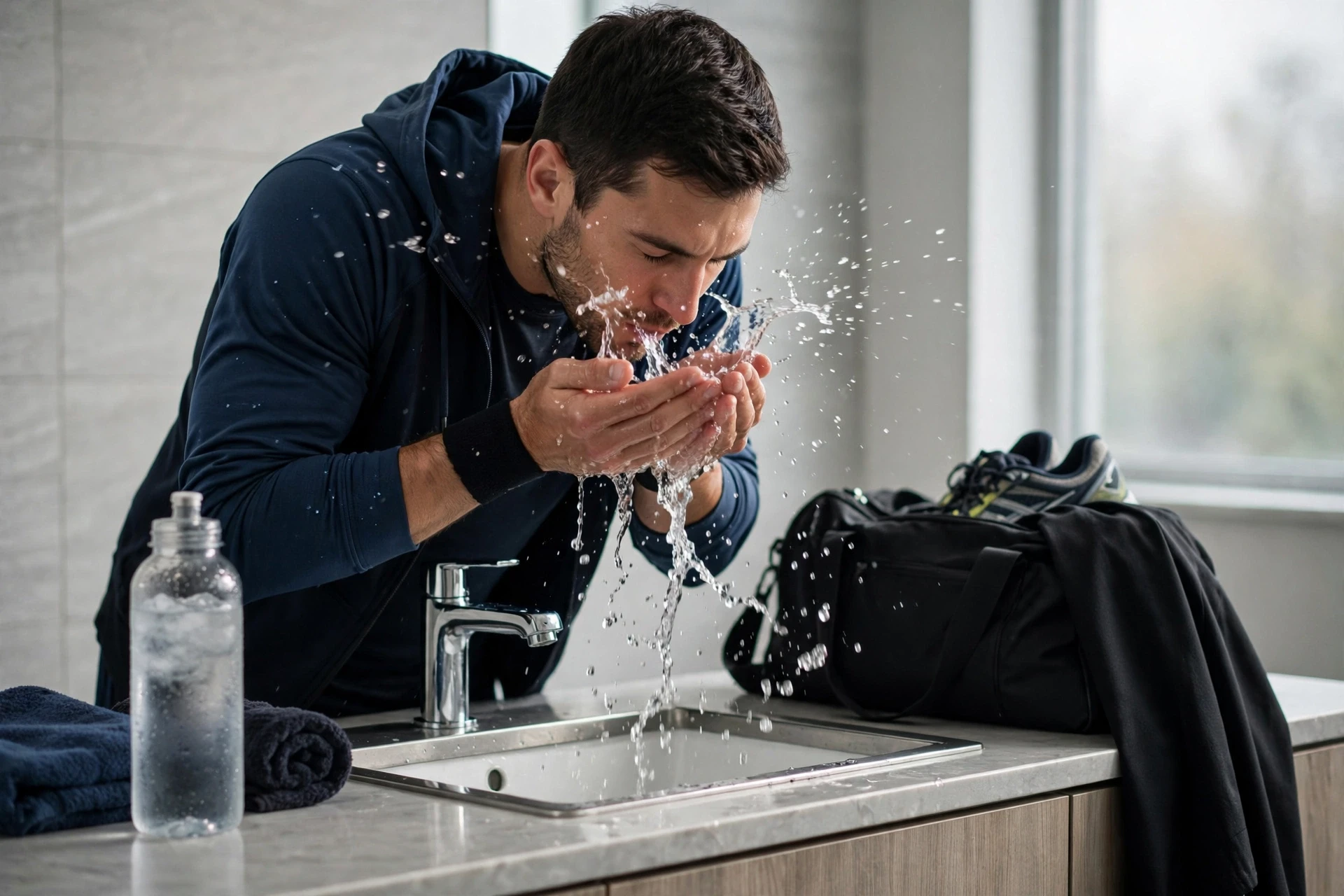
Splash cold water on your face or hold a cold bottle to your wrists. This triggers the dive reflex, a built-in switch that slows your heart rate fast. Cold on the face works best, according to research on panic and the diving response.
Move for Two Minutes and Change the Sensory Input
Your body burns off adrenaline through movement, not stillness. Walk briskly down a hallway, climb a few stairs or shake out your arms. Then change what you see, hear and touch: open a window, name five objects you can see and hold something with texture.
Get the Stress Out of Your Head and Onto Paper
Write down exactly what is stressing you, then one next action for it. Two minutes is enough. Paper holds the worry so your mind can drop it, which is one of the quickest stress relief techniques when your thoughts keep circling.
Step 4: Turn the Emergency Kit Into a Repeatable Calm Protocol
Practise the Protocol When You Are Still Calm
Run the full sequence once a day while you feel fine. Practicing calm without meditation under low pressure wires the steps in, so your body can find them fast when the fight-or-flight response spikes. Pick a fixed cue, like after your morning coffee, and time each phase so the whole routine takes under five minutes.
Know When Self-Care Stops Being Enough
Quick coping strategies have limits. If stress keeps waking you at night, or burnout symptoms linger for weeks, the nervous system needs deeper support than points and breathwork. That is when professional care helps: for example, treatment plans for burnout combine acupuncture with herbal prescriptions to rebuild baseline calm, not just short relief.
When stress keeps winning, Medicina Cinese offers personalized acupuncture and TCM care to restore calm, energy and focus. Book a consultation today.
Frequently Asked Questions
Q1: What are effective methods to calm down without meditation?
Use cyclic sighing, press Yintang or Shenmen (HT7), splash cold water on your face and move briskly for two minutes. These anxiety reduction tips work in under five minutes total.
Q2: What are the most effective quick methods to calm down without meditation in Italy?
Exhale-focused breathing, wrist-point pressure and the dive reflex are fastest. If stress persists, professional acupuncture in Milan or Lugano offers deeper support than self-care alone.
Q3: How can traditional Chinese medicine help reduce stress without meditation?
TCM uses acupressure points like Shenmen to settle the nervous system, and acupuncture with herbal prescriptions to rebuild lasting calm when burnout lingers.
Q4: What are practical non-meditation techniques to relax fast in Italy?
Between meetings or training, release jaw and shoulder tension, walk briskly, write one next action, then cool your wrists.
Conclusion
You can calm down without meditation in under five minutes: lengthen your exhale, release jaw and shoulder tension, press Yintang or Shenmen, then cool your face and move. Practise the sequence daily, and if stress lingers, deeper acupuncture care rebuilds lasting calm.