




Here's How to Find One Who Actually Can
You've read the articles. You've tried the breathing exercises. You still wake up exhausted before the day has started. Burnout doesn't respond to generic wellness advice — and the wrong therapist can leave you circling the same depletion for years without ever getting lighter.
This guide cuts through the noise. By the end, you'll know exactly what to look for, what to avoid, and why most people in burnout never receive care that matches what's actually happening in their body and nervous system.
Why So Many Burned-Out People Never Feel Better — and What That Tells You About Treatment
The most important thing to understand about burnout is that the healthcare system was not designed to treat it. Burnout has no official diagnostic code in most medical systems, which means it gets absorbed into adjacent categories — usually depression or anxiety — and treated accordingly. Research published in Frontiers in Psychology found that among people clinically identified as burned out, 58% were simultaneously diagnosed with depression and 59% with an anxiety disorder. The overlap is so significant it raises a legitimate question: when someone receives an antidepressant prescription for burnout, are they getting help — or are they getting the wrong answer to the right question?
This isn't a small problem. Over 82% of employees are considered at risk of burnout right now, yet the majority never receive care that targets it directly. The result is people who spend months — sometimes years — in therapy, on medication, or cycling through wellness programmes, and still cannot describe themselves as someone who has recovered. They manage. They cope. They do not feel lighter.
What to do today: Before booking with any practitioner, ask directly: "Do you have clinical experience specifically with burnout — not just stress or depression?" If the answer is vague, that's your signal to keep looking.
What Makes a Burnout Therapist Actually Effective (It's Not What Most People Expect)
The word "therapist" covers an enormous range of training, modality, and philosophy. A general talk therapist and a clinically trained integrative burnout specialist are not interchangeable, even though both might advertise support for stress and exhaustion.
Effective burnout recovery addresses at least three layers simultaneously: the psychological (thought patterns, identity, relationship to performance), the physiological (HPA axis dysregulation, cortisol dysrhythmia, autonomic nervous system imbalance), and in many cases the constitutional — the deeper depletion that TCM frameworks describe as Kidney deficiency or Jing exhaustion, the resource that chronic overwork burns through last and recovers slowest.
Conventional talk therapies — CBT, ACT, MBSR — have genuine value in the psychological layer. They are evidence-based, widely accessible, and useful for the cognitive patterns that often sustain burnout behaviour. But they do not touch the physiology. If your cortisol curve is dysregulated, if your sleep architecture has collapsed, if your immune system is signalling chronic inflammation — no amount of reframing your relationship with productivity will restore that. You need an intervention that reaches the body.
A 2024 review published in the Journal of Integrative Medicine documented how acupuncture modulates the HPA axis through neurotransmitter regulation, neuropeptide modulation, and microRNA activity in the hippocampus and amygdala — the precise neuroendocrine system that burnout dysregulates. This is not complementary in the decorative sense. It is mechanistically coherent intervention at the root of the problem.
What to do today: Look for a practitioner whose training spans both the psychological and the physiological. Ask: "How do you assess and address the physical stress burden — not just the mental one?"
The 5 Clinical Signs That Tell You Your Burnout Has Gone Deeper Than Stress
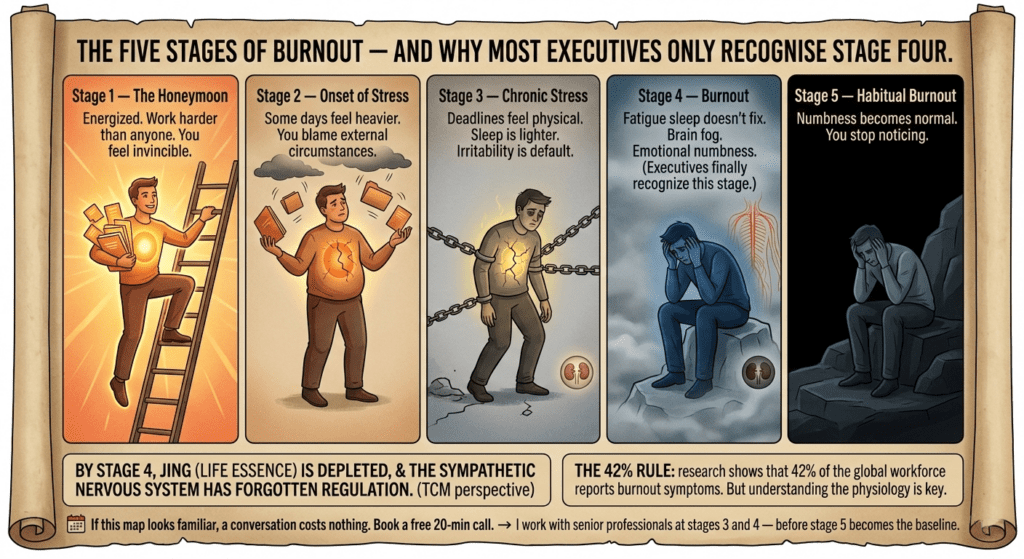
Stress and burnout are not on a continuum where one simply becomes the other with enough time. Burnout is a distinct physiological state — and recognising where you are in it determines what kind of help you actually need.
These are the five markers that indicate you have moved beyond early burnout into deeper depletion:
- Sleep that doesn't restore. You sleep eight hours and wake up as tired as when you lay down. The nervous system is not downregulating during sleep; it remains in low-grade activation throughout the night.
- Emotional flatness alongside exhaustion. Not sadness — numbness. The things that used to matter feel distant, not painful.
- Physical symptoms without clear cause. Recurring headaches, gut disruption, frequent illness, unexplained muscular tension. Chronic stress inflames, and inflammation is systemic.
- Cognitive erosion. Not normal tiredness affecting focus — a specific loss of processing speed, word retrieval, and short-term memory that feels qualitatively different from being stressed.
- Recovery resistance. A full weekend off, a holiday, even a sabbatical — and you do not bounce back the way you used to. Constitutional depletion has set in.
If three or more of these apply, you are past the point where lifestyle advice alone will move the needle. You need clinical input from someone who understands what chronic HPA activation does to the body over time.
What to do today: Be honest with yourself about how long these symptoms have been present and how much recovery you have already attempted. That timeline is clinically significant — bring it to your first appointment.
How to Choose the Right Practitioner: A Framework That Actually Filters
Most guidance on finding a burnout therapist stops at "check their credentials and see if you feel comfortable." That is necessary but nowhere near sufficient. Here is a more rigorous filter:
1. Specialisation over generalism. A practitioner who sees burnout as a subspecialty — not a variation of depression or anxiety management — will assess and treat it differently. Their intake process should reflect burnout-specific knowledge: questions about your work history, performance identity, HPA axis symptoms, and recovery pattern.
2. Body-inclusive methodology. If their entire approach operates at the level of the mind — thoughts, narratives, behavioural patterns — they will address only part of the picture. Ask specifically how they assess and work with the physiological dimension.
3. Root-cause orientation. Burnout has causes — not just triggers. A practitioner focused on root-cause resolution will want to understand what drove the depletion, not only how to manage its symptoms. Symptom relief matters and is part of the work; but if it is the only work, recovery will be partial.
4. Realistic timeline. Any practitioner who promises rapid resolution of clinical burnout is telling you what you want to hear. Physiological restoration is not fast. An honest practitioner frames recovery in phases, with meaningful milestones rather than a single destination.
5. Availability of telemedicine. If your burnout has reached the point where functioning at high capacity feels impossible, the last thing you need is logistical friction. Practitioners who offer structured remote protocols can deliver equally comprehensive care — sometimes more consistently — than in-person-only models.
What to do today: Run any practitioner you are considering through these five points before booking. If they can't answer clearly on points 2 and 3, move on.
The Role of Integrative Medicine: Why the Most Effective Burnout Recovery Spans Multiple Systems
The highest-functioning burnout recovery programmes are not single-modality. They combine psychological support with physiological intervention — and in the most comprehensive cases, with constitutional assessment that identifies the individual's specific depletion pattern rather than applying a generic protocol.
In Traditional Chinese Medicine, burnout is not one condition. It presents differently depending on which organ systems have been most depleted by chronic overwork, and the treatment is calibrated accordingly. A person burned out from years of emotional labour presents differently from a person burned out from relentless cognitive performance — and both present differently from someone whose exhaustion has accumulated over a decade of suppressed stress. Five-Element assessment maps the individual, not the category.
When acupuncture, laser acupuncture, and constitutional herbal support are combined with psychological input, what clients consistently report — across clinical experience spanning over 7 years — is not just symptom reduction. They describe feeling lighter. That specific quality: the sense of a weight that has been carried so long it became invisible, beginning to lift. That is what comprehensive, root-cause burnout recovery feels like from the inside.
It is also a marker that the intervention has reached deep enough. Feeling lighter is not a soft outcome. It is a sign that the nervous system is beginning to downregulate, that the HPA axis has found a more sustainable set point, and that the constitutional resources depleted by chronic stress are being actively restored rather than merely managed.
What to do today: If you have already tried psychological therapy without achieving this quality of recovery, consider whether the physiological and constitutional dimensions have been addressed at all. If they haven't, that is your next step.
FAQ: What People Actually Ask About Finding the Right Burnout Therapist
Is there a difference between a burnout coach and a burnout therapist?
Yes — and it matters clinically. A coach operates at the level of behaviour, goals, and performance strategy. A therapist is trained to work with the psychological roots of burnout: identity, emotional patterns, and the internal structures that made chronic overfunction possible. Neither, however, typically addresses the physiological dimension. A certified integrative or TCM practitioner adds that third layer — which is why the most thorough recoveries tend to involve more than one modality.
Can I feel lighter from burnout without quitting my job or changing my life completely?
Yes — though the answer depends on how deep the depletion has gone. Early burnout often responds well to targeted physiological support combined with boundary restructuring, without requiring dramatic external changes. Deeper burnout may require more substantial shifts — but the inner physiological work typically comes first. People who attempt life restructuring before restoring their nervous system often find they cannot sustain the changes they've made.
How do I know if I need a therapist, a TCM practitioner, or both?
The clearest indicator is whether your burnout presents primarily as a cognitive and emotional experience, or whether physical symptoms — disrupted sleep, immune dysregulation, persistent fatigue, somatic pain — are a significant part of the picture. If the physical dimension is present, psychological therapy alone will not resolve it. A practitioner who works across both systems is the most efficient path, particularly if you have already invested time in talk therapy without achieving full recovery.
How long does it realistically take to feel lighter after clinical burnout?
Meaningful shifts — the sense of something beginning to lift — typically emerge within the first three to six sessions of comprehensive integrative care. Full recovery, meaning sustained energy, restored cognitive function, and physiological resilience, takes longer: typically three to six months for moderate burnout, and up to twelve months or beyond for deep constitutional depletion. Anyone offering faster timelines should be approached with healthy scepticism.
Ready to Stop Managing Burnout and Start Recovering From It?
If you have been trying to feel lighter for months — or years — and the standard approaches have not delivered it, the issue is not your effort. It is the level at which the intervention is operating.
My work at Energy Angel addresses burnout at all three layers: psychological clarity, physiological restoration, and constitutional rebalancing through acupuncture, laser acupuncture, Five-Element assessment, and quantum energy medicine. I am Jasmine Angelique — a Swiss-certified TCM practitioner and naturopath with over 7 years of clinical experience across Barcelona, London, Milan, Lugano, and Belgrade, and worldwide via telemedicine. I am also the author of The Achievement Void, a clinical investigation into the burnout cycle that high performers don't see coming until they're already inside it.
This is not general wellness support. This is specific, root-cause, clinically grounded care for people who are serious about recovery — not just coping.
Book a discovery call here — and let's assess where you actually are, and what reaching lighter actually requires for you.
Sources
- Frontiers in Psychology — burnout, depression and anxiety overlap — https://www.frontiersin.org/journals/psychology
- Journal of Integrative Medicine — acupuncture and HPA axis regulation (2024) — https://www.journals.elsevier.com/journal-of-integrative-medicine
- American Psychological Association — burnout and stress — https://www.apa.org/topics/stress/burnout
- Energy Angel — acupuncture for burnout — https://medicinacinese.ch/en/acupuncture-2/
- Energy Angel — stress and burnout — https://medicinacinese.ch/en/difference-between-stress-and-burnout/
- Energy Angel — feel lighter naturally — https://medicinacinese.ch/en/feel-lighter-naturally/