


Most of the people who find their way to me have already tried everything that is supposed to work. They have the meditation app with the year-long streak. They have done the talk therapy, sometimes for years. They own the ring that scores their sleep and the tub that scores their willpower. And still, when they sit across from me, their shoulders are drawn up toward their ears and their breath never quite reaches their belly. They are doing all the right things, and they are still wired.
Over more than 7 years of clinical practice across Lugano, Milan, Barcelona, London and Belgrade, and now worldwide by telemedicine, I have come to believe that the entire idea of therapy to feel peace has been quietly sold to us backwards. We have been taught to chase a feeling. What the body actually needs is a capacity. This piece is about the difference, and about what genuinely changes it.
What does it actually mean to feel peace?
Peace is not a constant state of calm or bliss. Physiologically, it is far better understood as nervous system regulation, the ability of your autonomic nervous system to move fluidly between states. It mobilises energy when something demands it, and it recovers and restores when you are safe. The hallmark is not stillness. It is flexibility.
Three markers tell me whether someone has it:
- Heart rate variability. Higher variability signals good vagal tone and adaptability, a system that can shift gears rather than idle in high alert.
- Return to baseline. A regulated person recovers quickly after stress, without sliding into prolonged hyperarousal (racing thoughts, tension) or hypoarousal (numbness, shutdown).
- Interoceptive safety. The body reads its own internal signals, and its environment, as safe enough for digestion, rest, connection and clear thinking, instead of running a constant low hum of threat detection.
This is the practical heart of what Stephen Porges popularised as Polyvagal Theory, the role of safety cues in shifting us out of defence. The theory has its scientific critics on some anatomical points, and that is fair, yet its clinical usefulness for understanding body-based safety holds up in the treatment room every week. Regulation is capacity, not perpetual zen. You can feel anger, grief, even exhilaration, and move through the full range without being hijacked by it.
Peace is not a feeling of calm but a state of nervous system regulation, the capacity to move between activation and rest and return to baseline quickly. Its physiological markers are healthy heart rate variability, fast recovery after stress, and a body that reads its environment as safe. Regulation expands your emotional range rather than flattening it.
Why doesn't therapy make me feel at peace?
Here is the sharpest thing I will say, and I will put my name behind it. Much of the modern peace industry is selling symptom palliation and performance optimisation dressed up as deep healing, and it is keeping intelligent people stuck in a more sophisticated version of the same dysregulation they arrived with.
Two of its flagships deserve a closer look.
Talk therapy is genuinely good at reframing thoughts, building a coherent story, and solving problems. But for many people with chronic stress or trauma it stays top-down. It changes what you think about your experience without reliably rewiring the body's implicit alarm system. You can know, intellectually and completely, that you are safe, while your physiology continues to scan the room. That is the "I understand everything about my anxiety and I am still anxious" loop, and insight alone rarely closes it.
Meditation apps such as Calm and Headspace deliver accessible, short-term parasympathetic activation. They can take the edge off and help with sleep, and there is a place for them. The problem is that they tend to produce momentary calm rather than durable regulation. Practice is often context-free and one-size-fits-all. Someone in a shutdown state does not need more stillness, they need gentle mobilisation first. And for too many of my clients, the app simply becomes one more performance metric, another thing to be good at. The research summarised by the U.S. National Center for Complementary and Integrative Health is honest about this: mindfulness practices show real but modest effects, and they are not a cure for entrenched dysregulation.
None of this is anti-therapy or anti-app. It is anti-illusion. A ten-minute session can drop you into a calmer state, but if the underlying pattern is untouched, your baseline does not move. People stay reactive because the intervention never reaches the body's learned prediction of unsafety. If you recognise this pattern from the inside, my work on burnout and depletion in high achievers describes the territory in more detail.
Therapy and meditation apps often fail to create lasting peace because they work top-down or produce only momentary calm. Talk therapy can change what you think without rewiring the body's alarm system, and apps deliver short-term relaxation without shifting your physiological baseline. Durable peace requires addressing the body's learned prediction of threat directly, not layering more techniques on top of it.
What is the difference between the regulated self and the quantified self?
This distinction is the spine of how I work, so let me be precise about it.
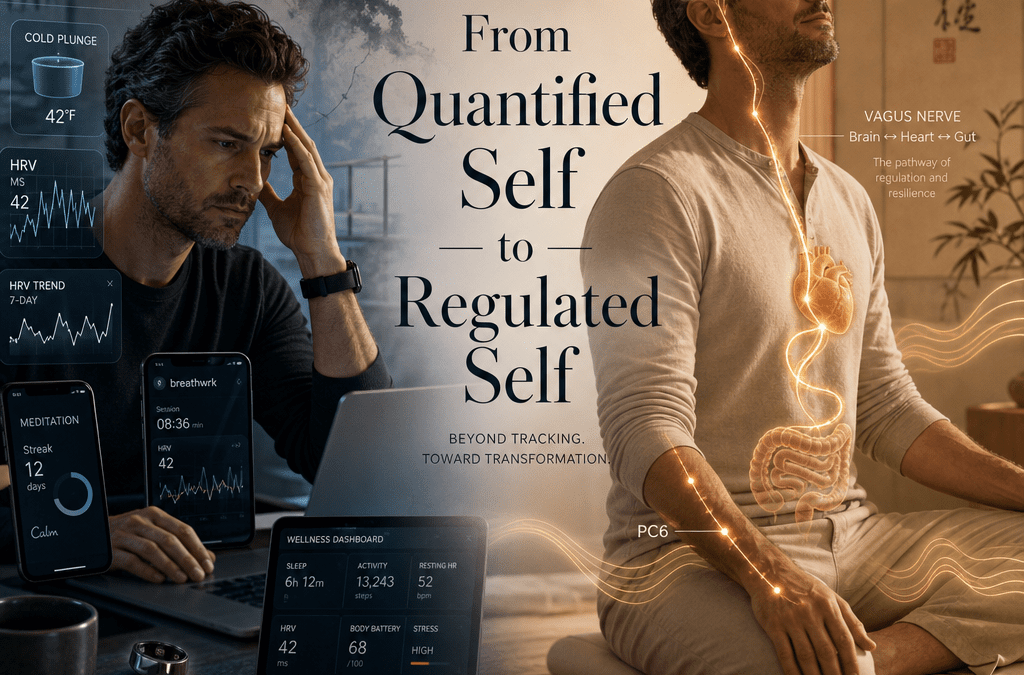
The quantified self is the founder with the Oura ring, the Whoop band and the nightly recovery score. The data is real and sometimes useful. But for many people it quietly fuels a new layer of arousal I call data vigilance, an anxious nightly check of whether you recovered "enough." You can post textbook HRV numbers and still live inside a narrow window of tolerance, intellectually certain of your safety while your body waits for the next hit. The metric becomes another mirror to perform in front of.
The regulated self targets something the dashboards cannot see, the predictive baseline of your nervous system, the way your autonomic responses, your interoceptive maps, and, in the language of Chinese medicine, your organ-system patterns anticipate the world. It is not about flattening everything into permanent calm or chasing the perfect number. It is about range. Mobilise powerfully when life calls for it, settle deeply when you are safe, and return to centre without heroic effort or an external crutch. Peace is not the absence of activation. It is agency in motion.
The quantified self measures proxies and outputs such as HRV scores, sleep stages and recovery metrics, which can create a new layer of anxiety called data vigilance. The regulated self targets the nervous system's predictive baseline, its learned anticipation of safety or threat. You can have excellent metrics and still be dysregulated, because numbers measure outputs while regulation is the underlying capacity.
How does Chinese medicine help the nervous system find peace?
This is where my work parts company with most of what you will read on the subject. Breathwork and cognitive tools are voluntary and top-down. They struggle to shift an entrenched physiological pattern on demand. Acupuncture works from the bottom up. It can directly modulate autonomic tone, move what we call stagnation, and nourish the depletion that leaves a system prone to collapse. Pulse and tongue diagnosis then give me, and the client, objective feedback that subjective "I feel a bit calmer" cannot.
In Chinese medicine the wired, frustrated, tight-jawed presentation is most often Liver Qi stagnation, frequently sitting over a background of Heart and Spleen deficiency (the anxiety and rumination, the poor grounding) and Kidney strain (the cost of years of achievement without true recovery). I am not treating a diagnosis from a manual. I am treating the specific pattern in front of me, read in real time. If you want the broader picture of what this medicine addresses, my overview of acupuncture and the nervous system sits alongside this article. The evidence base is also more substantial than skeptics assume, as the NCCIH summary on acupuncture and the UK NHS overview both reflect.
A case from my practice
I will describe a composite drawn from a pattern I see constantly, with details changed. Call him Alex, a tech founder in his late thirties. He had scaled a startup through punishing seasons and was now navigating post-funding burnout and new fatherhood, carrying a high-pressure upbringing in his body. On the surface he was articulate and driven. Underneath he was wired for constant vigilance. Sleep fragmented, digestion erratic, short with his partner, and a baseline edge that made simply being present with his infant feel like effort.
He had done everything. Years of good talk therapy. Daily app meditation. Wim Hof plunges, which sometimes left him more agitated, not less. Yoga, hard exercise, nootropics. Each gave him a peak of relief, and each time the dysregulation came back the moment stress returned.
On intake I saw upper-chest breathing, a tight jaw and shoulders, and a faintly scanning gaze. His pulse was rapid and wiry, especially in the Liver position, with a thin, depleted quality in the Kidney region, the signature of chronic strain on the reserves. His tongue was pale with a red tip and slightly scalloped edges, the Spleen taxed by worry. Polyvagally, his ventral vagal tone was low and he lived in sympathetic dominance with occasional drops into fatigue.
In sessions I combined acupuncture with quiet somatic tracking and very little talk. While the needles were in, calming the Heart and spirit, moving the stagnant Liver Qi, tonifying the Spleen and grounding the system, I had him notice subtle sensations, warmth, pulsing, the small trembling that signals discharge, and orient to cues of safety in the room. The needles produced a settling that his breathwork had never reliably reached.
The turning point came somewhere around the fourth to sixth session. Mid-treatment he felt a spontaneous, full-body tremor and release, a classic discharge of activation the body had been holding for years. His pulse softened under my fingers in real time. Afterwards he described, for the first time, his body simply knowing it was safe without being told to relax. The scanning eased. Digestion settled. Sleep deepened. By the third and fourth month his window of tolerance had visibly widened, and the apps became a support rather than the whole strategy. Real shifts in three to six weekly sessions, deeper regulation over two to three months. That is a realistic timeline, not a promise, and individual results genuinely vary.
What is the Embodied Pattern Reset method?
What I have just described is not improvisation. It follows a method I have developed across years of clinical patterns, which I call Embodied Pattern Reset. It is the part of my practice that is mine, and it is built to target the regulated self rather than chase a feeling. There are five steps.
- Pattern diagnosis. Pulse, tongue, presentation, history and real-time somatic tracking, mapping the specific stuck state rather than reaching for a generic technique. This is the precision that breathwork, CBT and apps simply do not have, objective markers of why regulation is not sticking for you specifically.
- Direct physiological reset. Acupuncture, or acupressure where appropriate, plus gentle somatic titration to move stagnation, nourish depletion, and create immediate cues of safety. This is the bottom-up input voluntary methods cannot reliably reach.
- Titration and completion. While the system is in its reset state, we gently allow incomplete defensive responses to finish, supported by the co-regulation of a calm practitioner. This is how implicit safety memory is built.
- Integration and re-patterning. We translate the felt shift into real life, boundaries, rhythmic practices, relational safety, with minimal quantification and maximal embodied feedback. How does your body know it is safe now?
- Exit and autonomy. As your baseline improves, we deliberately fade the tools. The goal is self-regulation, not dependence on input, mine or an app's.
The Embodied Pattern Reset method is a five-step integrative framework combining Chinese medicine and somatic, polyvagal-informed work. It moves through pattern diagnosis via pulse and tongue, direct physiological reset through acupuncture, titration and completion of stored stress responses, integration into daily life, and finally exit toward independent self-regulation. It targets the body's specific pattern rather than applying generic relaxation techniques.
Can I start regulating my own nervous system at home?
Yes, with realistic expectations. The needles and the pulse reading need a practitioner, but I always send people home with something real. These are the things I actually give clients, stripped of apps and performance pressure. Do them gently, consistently, and with curiosity about what your body reports back.
Acupressure points I send people home with
Find somewhere safe to sit or lie down. Use firm, comfortable pressure with a thumb or finger, enough to feel it, never enough to bruise, and breathe slowly with longer exhales.
- PC6, the Inner Gate. On the inner forearm, about three finger-widths above the wrist crease, between the two tendons. Press or massage in small circles for one to two minutes per side while you exhale slowly. This is my first choice for the wired, restless edge. It calms the Heart and spirit and often softens racing thoughts and upper-chest tension faster than any box-breathing count. Use it when you catch yourself scanning, or before bed.
- LV3, the Great Surge, paired with LI4. LV3 sits on the top of the foot, in the hollow between the big toe and second toe, about two thumb-widths back from the web. Press firmly for one to two minutes per side. Add LI4, in the webbing between thumb and index finger, for the classic Four Gates effect. This combination is powerful for Liver Qi stagnation, the irritability, the tight shoulders and jaw, the frustration that breathwork tends to skate over. Do it daily when you feel stuck or reactive.
Two practices I trust more than app breathwork
App breathwork is often too forced, or it nudges people toward dissociation. These emphasise felt safety and gentle discharge instead.
- Orienting with an extended exhale and sound. Sitting or standing, slowly turn your head and eyes to scan the room, left, right, up, down, as if gently checking whether you are safe here. Let the gaze soften. Then inhale through the nose and exhale longer, a count or two longer, making a low humming or "vooo" sound from the chest and belly. The vibration stimulates the vagus directly. Five to eight cycles. This builds genuine ventral vagal tone through safety cues and vibration, not forced calm.
- Grounded self-holding. Cross your arms and place your hands on the opposite shoulders or ribs, a gentle self-swaddle. Feel your feet on the floor and the support beneath you. Breathe naturally, and allow any subtle shaking, pulsing or warmth to happen without forcing or stopping it. Stay three to ten minutes. The deep pressure invites a parasympathetic shift, and the body completes small stored responses that talking and apps usually bypass.
Track not how calm you feel in the moment, but how your baseline capacity shifts over days and weeks. That slower measure is the regulated self showing up.
You can begin regulating your nervous system at home with acupressure and body-based practice. Press PC6 on the inner forearm for one to two minutes with slow exhales to calm a wired state, and use LV3 with LI4 for tension and irritability. For practice, try orienting your gaze around the room with an extended humming exhale, or grounded self-holding for three to ten minutes. Track your baseline over weeks rather than momentary calm.
When is self-help not enough?
Self-work is excellent for maintenance and for milder patterns, but it has limits, and a good practitioner tells you where they are. Come and see someone, ideally an integrative and licensed practitioner, if any of the following is true.
- Your system stays stuck in hyper-alert scanning, tight freeze or heavy shutdown despite weeks of consistent practice. The "I do all the things and I am still wired or numb" loop.
- Old sensations, emotions or memories surface strongly during these practices and do not settle.
- Daily life is affected. Sleep will not stabilise, digestion stays off, the same relationships keep triggering the same reactivity, or you cannot reach presence with the people you love.
- You have a clear trauma history and the body feels either too much or too far away to work with alone.
If you are in acute distress or crisis, please reach out to a qualified medical or mental health professional in your area first. The work I do is for the chronic, stuck pattern beneath ordinary high-functioning life, and it compounds fastest with the co-regulation of a practitioner who can read your specific pattern and give your system the precise input it needs.
Where to begin
If you have read this far, you are almost certainly someone who has already tried the obvious things and sensed that your nervous system is the missing piece. The next step is not another protocol. It is a reading of your specific pattern.
I invite you to book a discovery call, where we look at your presentation and history, begin to map your pattern, and decide together whether the Embodied Pattern Reset approach is right for you. I work in person across several European cities and by telemedicine worldwide, so where you are need not decide whether you begin.
Peace, the real kind, is not a feeling you have to achieve and hold. It is the quiet confidence that you can meet whatever arises, move through it, and return to centre. That is the regulated self. It is learnable, and it is worth the depth it asks of you.
Fuentes
- NCCIH Acupuncture — https://www.nccih.nih.gov/health/acupuncture-what-you-need-to-know
- NCCIH Meditation and Mindfulness — https://www.nccih.nih.gov/health/meditation-and-mindfulness-what-you-need-to-know
- NHS Acupuncture — https://www.nhs.uk/conditions/acupuncture/
- Polyvagal Theory (Porges) overview — https://www.ncbi.nlm.nih.gov/pmc/articles/PMC2367686/
- Discovery call — https://tidycal.com/energyangel8