



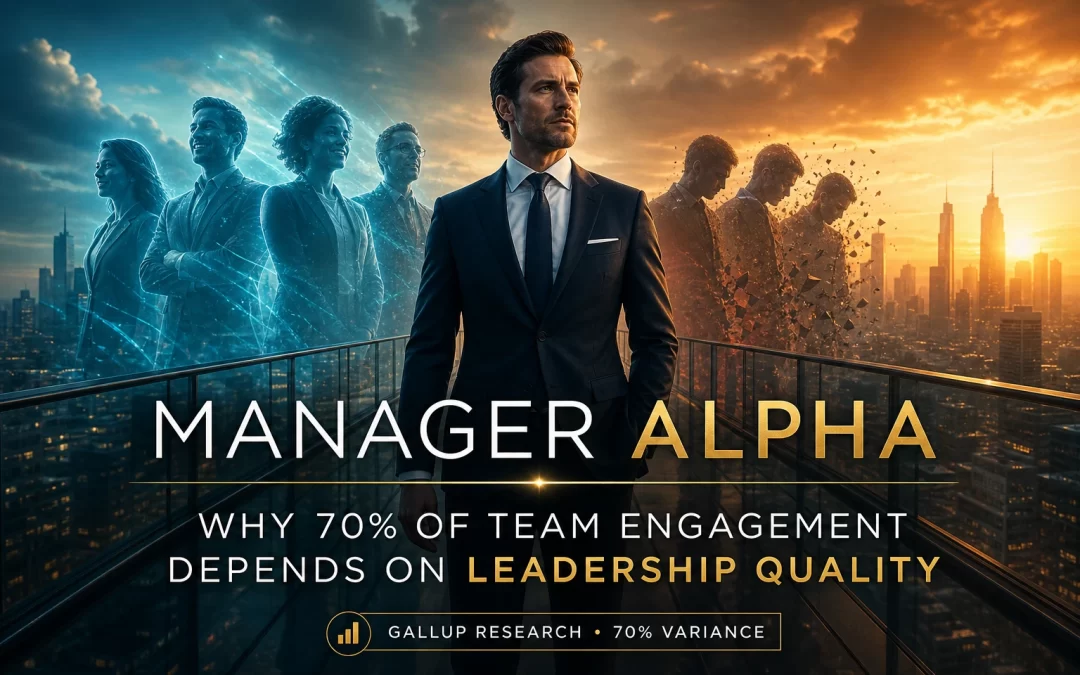
Gallup’s latest data is unambiguous. Managers don’t just influence teams — they are the team. Here’s what the research says, why it’s getting worse and what leaders at the top of their game actually do differently.
Related reading: Burnout Coach for Founders and CEOs · CEO Alpha: Why GPs’ Leadership Returns High-Performance Founders
Here is an uncomfortable truth most executives do not want to sit with: your direct manager shapes your experience of work more than your company’s mission, your salary, or your CEO’s vision combined.
This is not an opinion. It is one of the most replicated findings in twenty years of workplace research. Gallup’s State of the American Manager study established that managers account for at least 70% of the variance in team-level employee engagement — a figure that has remained stable across re-analyses from 2015 through 2026, ranging between 67% and 72%. Every subsequent State of the Global Workplace report has reaffirmed it.
The implications are stark. A great manager can take a mediocre team and produce exceptional output. A poor manager can take your highest performers and quietly destroy them within eighteen months. Company culture is not built from the top — it is built from the middle, one team at a time, one manager at a time.
And right now, that middle layer is in crisis.
“Managers account for at least 70% of the variance in team engagement — a finding stable across two decades of Gallup research. Everything else is noise.”
The Data You Need to Know — and Why It’s Getting Worse
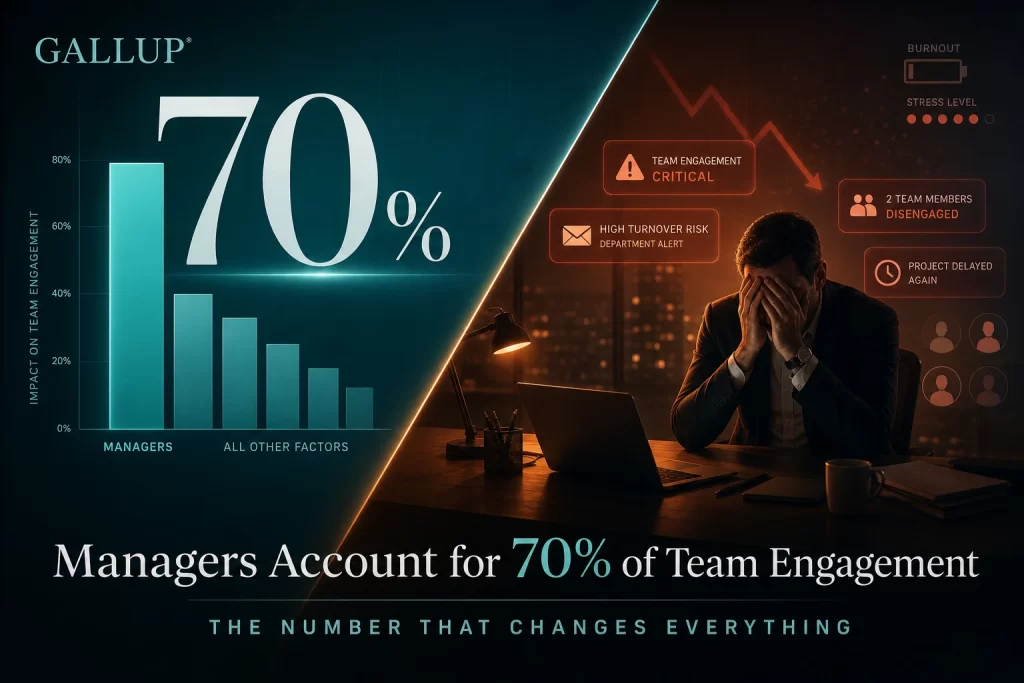
The numbers coming out of Gallup’s 2026 State of the Global Workplace report are sobering. Global employee engagement fell to 20% in 2025 — the third consecutive year of decline and the lowest level ever recorded. That single percentage point drop represents approximately 21 million workers who psychologically checked out of their jobs in one year.
The cost: Gallup estimates the 2024 decline alone wiped out $438 billion in global productivity. The broader toll of disengagement across the entire workforce runs to $8.8 trillion annually — roughly 9% of global GDP.
What is driving it? Not compensation. Not hybrid work. The primary driver, according to Gallup, is a collapse in manager engagement.
Between 2024 and 2025, manager engagement dropped five percentage points in a single year — from 27% to 22%. That is the largest single-year decline on record. Managers used to enjoy what Gallup calls an “engagement premium” over the people they led. That premium has essentially disappeared. Managers are now no more engaged than the individual contributors on their teams. When managers disengage, teams follow. When teams follow, business performance erodes.
The burnout picture is equally stark. 56% of leaders reported feeling burned out in recent surveys — up from 52% the prior year. Middle managers are the hardest hit: 71% of middle managers in the US reported burnout in 2025, more than any other employee group. According to DDI’s Global Leadership Forecast 2025, 71% of leaders reported increased stress levels, up from 63% in 2022. And 40% of stressed leaders have considered leaving their leadership roles entirely to recover their wellbeing.
These are not abstract statistics. They describe the person running your product team, your sales organisation, your engineering department. They describe, in many cases, you.
The Cascade Effect: How One Manager’s State Becomes Everyone’s Problem
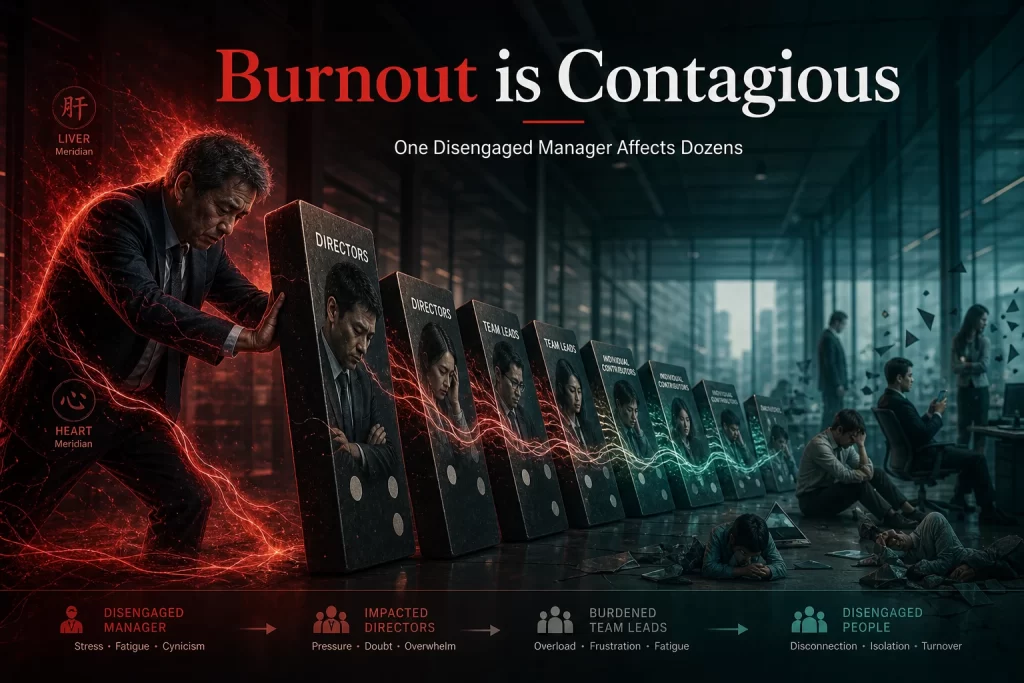
The mechanism through which manager burnout spreads is well-documented and predictable. It does not require any malicious intent. It is simply what happens when a system under sustained pressure passes that pressure downstream.
A burned-out or disengaged manager typically operates in a set of recognisable patterns:
- Unclear expectations: team members work in a permanent fog of ambiguity, expending energy on guessing rather than delivering.
- Reactive rather than strategic: perpetual firefighting crowds out planning, development and recovery time for the whole team.
- No meaningful feedback: annual reviews replace ongoing coaching, leaving people without the real-time calibration they need to grow.
- Invisible boundaries: the implicit message is that more hours equal more commitment — that stopping is weakness.
- Psychological unsafety: admitting capacity limits or asking for help becomes career risk, so problems stay hidden until they become crises.
The result is measurable. Employee stress rises. Top performers — who always have options — leave first. The remaining team becomes demoralised. Productivity falls even as hours rise. And the manager, watching results deteriorate, typically responds by pushing harder — the exact behaviour that caused the problem.
The math is brutal. One burned-out manager in a senior role can cascade dysfunction to eight to fifteen direct reports within months. In a mid-size organisation, a single disengaged VP can affect fifty or more people within two quarters, through their direct team and the managers who report to them.
“Burnout is contagious. One disengaged director does not stay isolated — the state propagates through every layer below.”
What Elite Teams Actually Do Differently

I have spent fifteen years coaching elite athletes alongside my work in integrative medicine. The parallels between high-performance sport and high-performance organisations are closer than most executives want to admit — and the differences are instructive.
Championship teams and their coaches operate on principles that most corporate environments have systematically discarded:
1. Clarity of expectation, continuously updated
Elite athletes know exactly what they are being asked to produce, in what timeframe, measured how. The goal is never vague. In most corporate teams, “be a self-starter” passes for direction. It does not.
2. Designed intensity, not infinite intensity
No serious sports programme runs athletes at maximum output without structured recovery. Sprint cycles are followed by reset periods. Overtraining syndrome — the athletic equivalent of burnout — is something coaches are trained to prevent, not manage after the fact. Corporate culture has somehow convinced itself that endless intensity is a virtue. The physiology disagrees.
3. Individual capacity assessment
A good coach knows that not every athlete can train at the same volume on the same day. Assessing individual state and adjusting load accordingly is not coddling — it is expertise. Most managers have no framework for this conversation at all.
4. Real-time, specific feedback
In sport, feedback is immediate, targeted and tied to observable behaviour. In most organisations, it is annual, generic and delivered in a format that serves HR compliance more than actual development.
5. Psychological safety as a performance condition, not a HR initiative
Athletes who cannot admit limits or report problems get injured. Teams where vulnerability is punished do not win championships. This is not about being kind — it is about information flow. Leaders who cannot hear bad news early make worse decisions.
6. Recovery modelled from the top
When coaches and senior staff model recovery — demonstrable rest, nutrition discipline, stress management — the culture follows. When they model overwork as identity, the culture follows that instead. Teams take their cues from what leaders do, not what they say.
“The best coaches I have worked with share one trait: they treat recovery as a performance input, not a reward for good performance. Corporate managers rarely think this way.”
The TCM Lens: Why “Toxic Heat” Is Not a Metaphor
In Traditional Chinese Medicine, sustained stress without recovery creates a pattern we call “toxic heat”: an accumulation of unprocessed Yang energy that, left unchecked, damages the organ systems — particularly the Heart, Liver and Kidneys — and manifests as inflammation, sleep disruption, decision-making failure and emotional dysregulation.
What makes this clinically relevant in a leadership context is that toxic heat is, in TCM terms, contagious. Stress is physiologically contagious through the mechanism of mirror neurons and co-regulation of the autonomic nervous system. A manager in a sustained high-cortisol state literally dysregulates the nervous systems of the people around them. You do not need to believe in Qi to accept the neuroscience: chronic stress in leaders propagates measurable stress markers in their teams.
The antidote in TCM is not simply “stress less” — it is the restoration of Yin-Yang balance through intentional recovery, rhythm and sustainable output cycles. In practical terms, this means:
- Building recovery phases into work rhythms the same way athletes build them into training blocks.
- Assessing the energetic state of the team regularly — not waiting for burnout to become visible.
- Understanding that a manager who models depletion creates a depleted team — no amount of motivation compensates for structural imbalance.
This is the foundation of the APEX CODE Method™ — an integrative framework for sustainable high performance that draws on TCM diagnostics, energy medicine and evidence-based performance science. If you want to understand the clinical detail behind this approach, the burnout coaching page for founders and CEOs covers it in depth.
The 5-Point Manager Audit: Is Your Leadership Creating or Destroying Engagement?
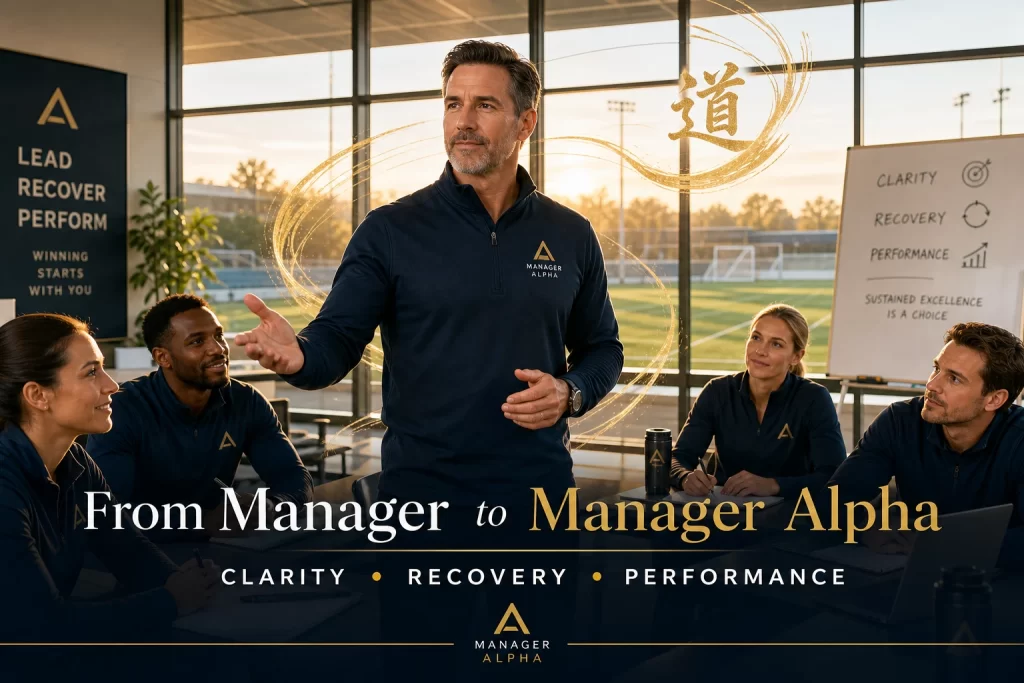
Before any intervention, leaders need an honest read on where they currently stand. The following audit is designed to be uncomfortable. That is the point.
Signs your leadership style is destroying engagement
- Constant urgency as default: Slack messages at 11 PM. Weekend emails marked important. The phrase “this can’t wait” used more than once a week. If everything is urgent, nothing is strategic — and your team is running on cortisol, not clarity.
- No boundaries, no permission to stop: Your reports do not know when they are allowed to finish for the day. They model their hours on yours. If you never stop, they never stop.
- Feedback as an annual event: If your direct reports only receive real assessment of their work once a year, they are navigating blind for eleven months. They are also storing resentment, confusion and unaddressed performance gaps that compound over time.
- Visible burnout in your team: You can see it — the cynicism, the exhaustion, the people going through the motions. Only 42% of burned-out workers tell their manager. The ones who do not tell you are the ones you should be most concerned about.
- Your best people are leaving: Top performers leave first because they have the most options. If your high performers are exiting at a higher rate than your average performers, your management style is the primary variable to examine.
Signs your leadership style is creating engagement
- Your team works hard in defined phases — and recovers deliberately between them.
- People on your team tell you when things are not working, early enough to fix them.
- Your 1-on-1s are coaching conversations, not status updates.
- Your team is healthy, curious and still developing — not depleted and marking time.
- Good people want to work for you. Referrals come in. Talent finds you.
Rule of thumb: if three or more of the first five resonate, the leadership model is the problem. Not the individuals on the team. Not the market conditions. The model.
What the Business Case Actually Looks Like
Engagement is not a soft metric. It has hard financial consequences that can be calculated at the team level.
Gallup’s 2026 data on top-quartile versus bottom-quartile engagement teams shows:
| Metric | Low Engagement | High Engagement |
| Profitability | Baseline | +23% |
| Productivity | Baseline | +18% |
| Turnover (high-turnover orgs) | Baseline | 59% lower |
| Absenteeism | Baseline | 81% lower |
| Customer satisfaction | Baseline | +10% |
| Cost of disengagement (global) | $8.8T/year | — |
At the individual team level, the calculation is direct. A manager leading a ten-person team, moving from low to high engagement, generates a conservative estimated impact of $200,000 to $500,000 in combined productivity gains and reduced turnover costs — before accounting for quality improvements, faster delivery or reduced absenteeism.
This is not a wellness investment. It is a performance investment with measurable return.
Three Shifts That Actually Change Things
Transformation at the manager level does not require a complete personality overhaul. It requires three specific behavioural shifts, consistently applied over time.
Shift 1: From reactive to strategic (Qi management)
The manager who is permanently firefighting is not managing — they are reacting. The shift is from responding to every urgent signal to designing systems that prevent urgency from becoming the default state.
Practically: are you running daily standups when weekly would suffice? Do your team members know their work has a defined end? Is your calendar shaped by your priorities or by everyone else’s? The answers reveal whether you are operating strategically or surviving tactically.
Shift 2: From feedback scarcity to feedback flow
Annual reviews are not feedback. They are documentation. Real feedback is specific, timely, tied to observable behaviour and oriented toward growth. The cadence needs to be weekly or monthly, in a format where the person receiving it can actually use it.
The structural fix: convert your 1-on-1s from status updates into coaching conversations. Fifteen minutes on what is happening; thirty minutes on how the person is developing and what they need from you. The impact on engagement and retention is disproportionate to the time investment.
Shift 3: From modelling overwork to modelling recovery
This is the hardest shift for high-performing leaders because overwork has often been the behaviour that got them to their current position. It feels like identity. It is actually a liability.
When you take your full vacation with no email. When you have a shutdown time and honour it. When you tell your team explicitly that 45 hours is enough and you mean it — you are giving them permission to function sustainably. The research is unambiguous: sustainable teams outperform depleted teams on every metric that matters over any period longer than six months.
“The paradox of recovery in high-performance contexts: asking for less effort consistently produces more output. The physiology is not complicated. The belief system is.”
The Manager Alpha Approach
Manager Alpha is the framework I use when working with leaders whose teams are underperforming, burning out or losing talent they cannot afford to lose. It integrates TCM-informed energy assessment with evidence-based performance science and practical behavioural coaching.
The three-component structure:
- Manager Audit (90 minutes): A structured assessment of current manager effectiveness, burnout risk in the team and the specific behavioural patterns creating disengagement. Output: a clear picture of what is breaking and a prioritised set of interventions.
- Manager Alpha Coaching (12 weeks): Weekly coaching sessions for the manager, combining TCM energy diagnostics, practical team engagement strategies and accountability for the three behavioural shifts. Measurable improvement in engagement scores is the tracked outcome.
- Team Wellness Integration: For teams already in burnout, a structured recovery protocol combining acupuncture, energy medicine and sustainable performance practices — addressing the physiological dimension of burnout that behavioural coaching alone cannot reach.
If you are working at the executive level and want to understand how this integrates with leadership performance more broadly, the CEO Alpha article on leadership in private equity covers the senior leadership dimension in detail.
Frequently Asked Questions
Is this relevant to me if my team is performing well on paper but I can feel something is off?
Yes. Lagging engagement indicators — the ones you feel before you can measure — are the most actionable. Waiting for turnover to spike or quality to drop means you are already in recovery mode. Intervening when things feel slightly off is always cheaper and faster than intervening after the team has fractured.
My own schedule is not sustainable. Where do I start?
With your own recovery. This is not self-indulgence — it is operational. A manager who is in chronic depletion cannot accurately assess their team’s state, cannot regulate their own reactions under pressure and cannot model anything other than overwork. Your recovery is a leadership act.
What is the TCM component actually adding to a leadership framework?
Diagnostic precision about the physiological dimension of burnout that Western performance frameworks typically miss. TCM pattern diagnosis identifies which organ systems are under strain, how depletion is expressing — adrenal exhaustion looks different from liver overload in TCM terms and requires different interventions. It also provides a framework for assessing team energy collectively — not just asking “how are you” but actually reading the system.
How quickly can engagement scores change with manager-level intervention?
In the cases I have worked with, meaningful movement in team engagement scores is typically visible within eight to twelve weeks of consistent manager behaviour change. The highest-leverage early actions are feedback frequency and explicit recovery modelling — both of which cost nothing but time and intention.
Your Next Step
If three or more of the audit signals in this article resonated — either in your own leadership or in a manager you are responsible for — the appropriate response is not to circulate an article. It is to intervene.
I work directly with executives, managers and HR leadership on exactly this. The starting point is a discovery call — a 20-minute conversation to assess the situation and identify whether the Manager Audit, the coaching programme or the team recovery protocol is the right entry point.
The data is not ambiguous. Your managers are your company. The question is whether the ones you have are building something or quietly burning it down.
References
Gallup State of the American Manager 2015
Gallup State of the Global Workplace 2026
DDI Global Leadership Forecast 2025
Eagle Hill Consulting Workforce Burnout Survey 2025
Jasmine Angelique, TCM practitioner ; 24th May 2026 ; updated today
Schema markup to add: Energy Angel,
Manager Alpha: Why 70% of Team Engagement Depends on Leadership Quality
© 2026 medicinacinese.ch · Written by Jasmine Angelique, certified TCM practitioner, naturopath and integrative medicine specialist. · This article is for informational purposes and does not constitute medical or HR advice.