



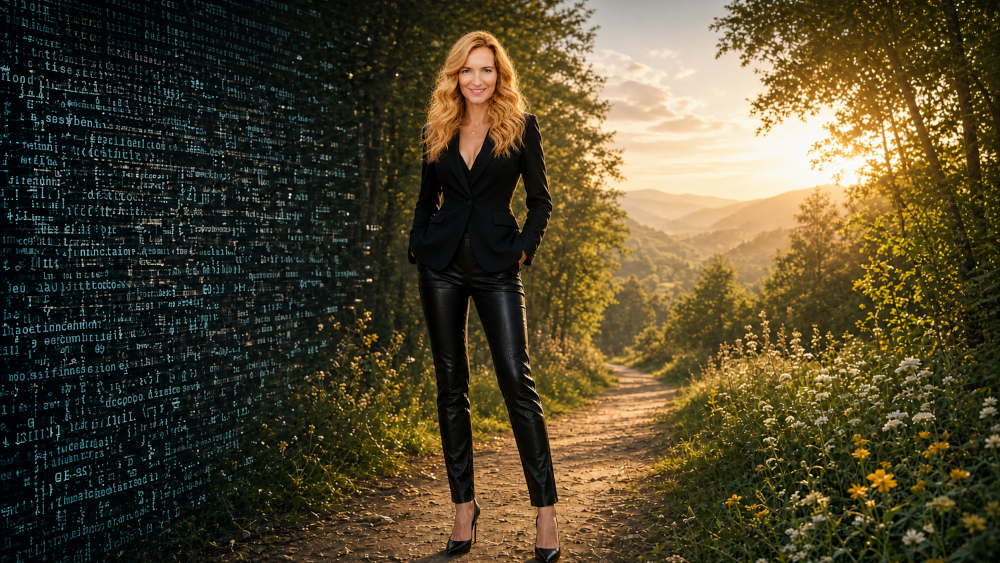
Scrolling LinkedIn, I ran into a puzzling picture with a grim definition: Reality is the world as it is, the place where old assumptions no longer apply. Talking about how Europeans have to adapt to it. I disagree.
That propaganda treats reality as a finished object we simply have to endure. What I believe is completely different and I want to describe it by referencing the material I’ve been sitting with lately—Tom Campbell’s virtual-reality model of consciousness, conversations about whether consciousness renders the physical world and Robert Greene’s exploration of the sublime—points to something more fluid and participatory.
Campbell starts from a physicist’s intuition that consciousness is fundamental and the physical universe is a rule-bound virtual environment computed from information. Individual consciousnesses (he calls them “entities”) play through avatars inside tight constraints so that choices have real consequences. The evolutionary pressure, he says, is toward lower entropy: cooperation and care reduce disorder; fear and self-interest increase it. Life’s purpose is therefore not merely to survive the simulation but to grow the quality of consciousness itself—toward love rather than the performance of love.
A parallel thread appears in discussions of whether consciousness actively renders reality, the way a game engine only draws the map the player is currently in. The claim is not proven, and the speakers are careful to separate personal experience from shared scientific fact. Still, the metaphor is powerful: if the “map” responds to the quality of attention and intention we bring, then reality is less a fixed prison and more a collaborative process.
Robert Greene approaches the same territory from the human side. He distinguishes the true sublime—awe and connection that arise from direct engagement with the world—from both the “anti-sublime” (the hard-edged reduction of everything to dead facts) and the “false sublime” (quick chemical or digital stimulation). Childhood, he notes, is naturally oriented outward; adulthood often reverses that ratio until we live almost entirely inside self-referential worry. Recovering wonder does not require a near-death experience or a metaphysical system; it requires the deliberate practice of attention, risk, and care.
Put together, these perspectives suggest that the resigned LinkedIn slogan is only half the story. Reality is not merely “the world as it is.” The world which “Europeans have to face” ?!
It is the ongoing process by which consciousness meets constraint, reduces entropy through better choices, and occasionally renders something more luminous than the previous frame. We can step back from being limited and thinking in a negative and limiting way. I believe in Europe and our values and culture. Our borders and our welcoming and not welcoming sides. Our freedom to have a walk being dressed sexy, freely, as we like and be and feel safe. That has always to stay with us and our future generations. That is our identity and is always our reality.
In that light, reality is not bad, nor negative, nor hopeless. It is demanding, consequential, and—if we treat it as a process rather than a finished object—capable of becoming something wonderful IF we actively help preserve it.