


Quick Summary: A discreet 90-second desk routine can ease acute anxiety by combining five cycles of 4-6 breathing, pressure on the PC6 and HT7 wrist points, and a light palm rest on the sternum. Grounding your gaze on one neutral object and labeling the worry on paper can help interrupt a thought loop, while repeating the routine over two weeks may make it more effective. If recurring anxiety affects sleep or causes chest tightness, seek professional care, including a Chinese medicine diagnosis through practitioners such as Medicina Cinese.
It’s 15:40 in an open-plan Milan office. Your chest tightens before a client call, and you have about ninety seconds to settle it without the colleague across the table noticing. That’s the real problem: most anxiety relief tips assume privacy you don’t have. This guide gives discreet ways to calm down at your desk, including wrist acupressure points, a 4-6 breath ratio and grounding techniques drawn from Chinese medicine practice.
Step 1: Slow the Exhale First, Before Anyone Sees a Change
The 4-6 pattern you can run mid-sentence. Breathe in through your nose for a count of four, then out slowly for six. No posture change, no closed eyes, no sound. Run the 4-6 breathing technique in cycles of five, about a minute, while typing or listening. Among discreet ways to calm down at your desk, this is the fastest one to hide.

Why the long exhale, not the deep breath, does the work. A longer exhale activates the parasympathetic nervous system, the branch that slows your heart rate. Deep chest breaths can do the opposite and feed the tension. In Chinese medicine terms, breath rules the Qi; exhaling fully lets it settle. Keep the ratio, not the depth, your focus.
Step 2: Press the Points That Calm a Racing Heart
| Point | Where to find it | Pressure | Duration |
|---|---|---|---|
| PC6 | Three finger-widths above the inner wrist crease | Firm thumb press | 1-2 minutes |
| HT7 | On the wrist crease, small-bone side of the pinky | Gentle circular press | 1 minute |
| Yintang | Between the eyebrows | Soft fingertip hold | 30-60 seconds |
| Sternum center | Middle of the breastbone | Palm rest, light pressure | 1 minute |
PC6 and HT7: the wrist points that fit inside a closed hand
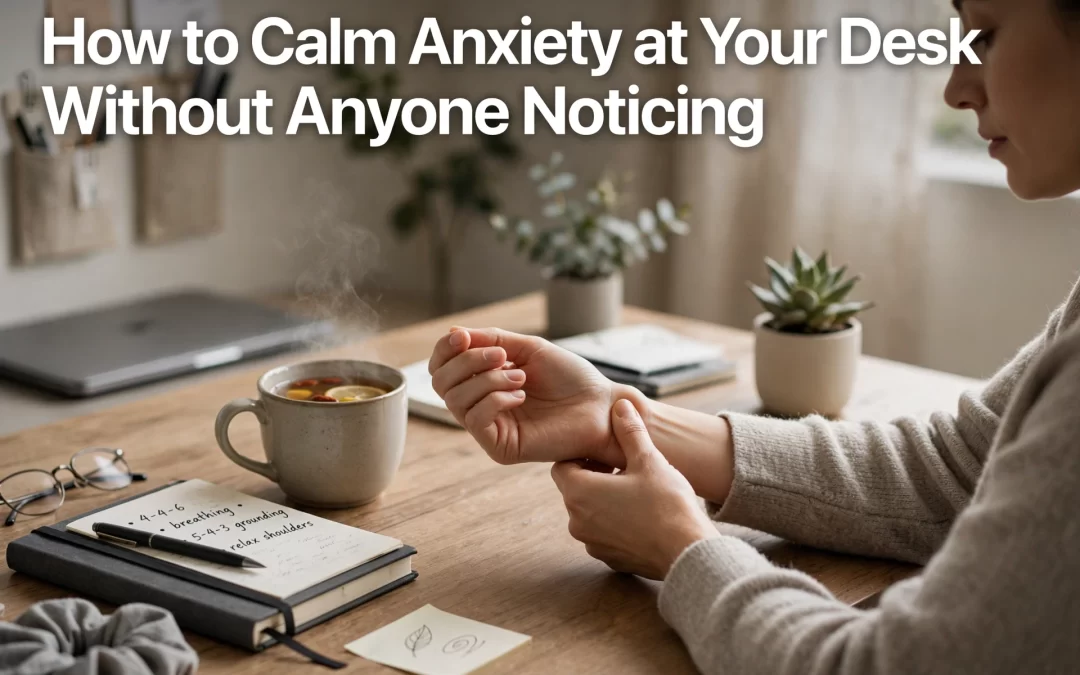
Curl your fingers over your wrist and you can reach both points at once. Your thumb settles on PC6, your fingertips on HT7. Squeeze slowly while reading an email and the heart’s racing rhythm often settles too. In Chinese medicine, this pair regulates qi at the heart and pericardium meridians. Practitioners of Chinese medicine, like those at Medicina Cinese, use them in treatment rooms because they reliably steady a nervous system under load.
Yintang and the sternum: calming from the face and chest
For visible panic less visible: rest one fingertip between your eyebrows as if checking your forehead. Thirty seconds is enough. Then lay your flat palm on the middle of your chest. This pair switches on the parasympathetic nervous system, the calm branch your body forgets to use during back-to-back calls.
The neck and shoulder release that passes for a stretch break
Rotate your head slowly left, then right. Drop your ear toward each shoulder for three breaths. Press the muscle at the top of your neck with two fingers. Nobody at a desk next to you reads this as anxiety; it reads as stress reduction ideas everyone should use anyway.
Step 3: Interrupt the Thought Loop in Under Two Minutes
When the spiral starts, drop your gaze to a single neutral anchor: your coffee cup, the edge of your desk, a fixed point on the wall. In Chinese medicine, this is a grounding technique at work, drawing scattered energy back to the body. A discreet anxiety solution anyone can run mid-meeting.
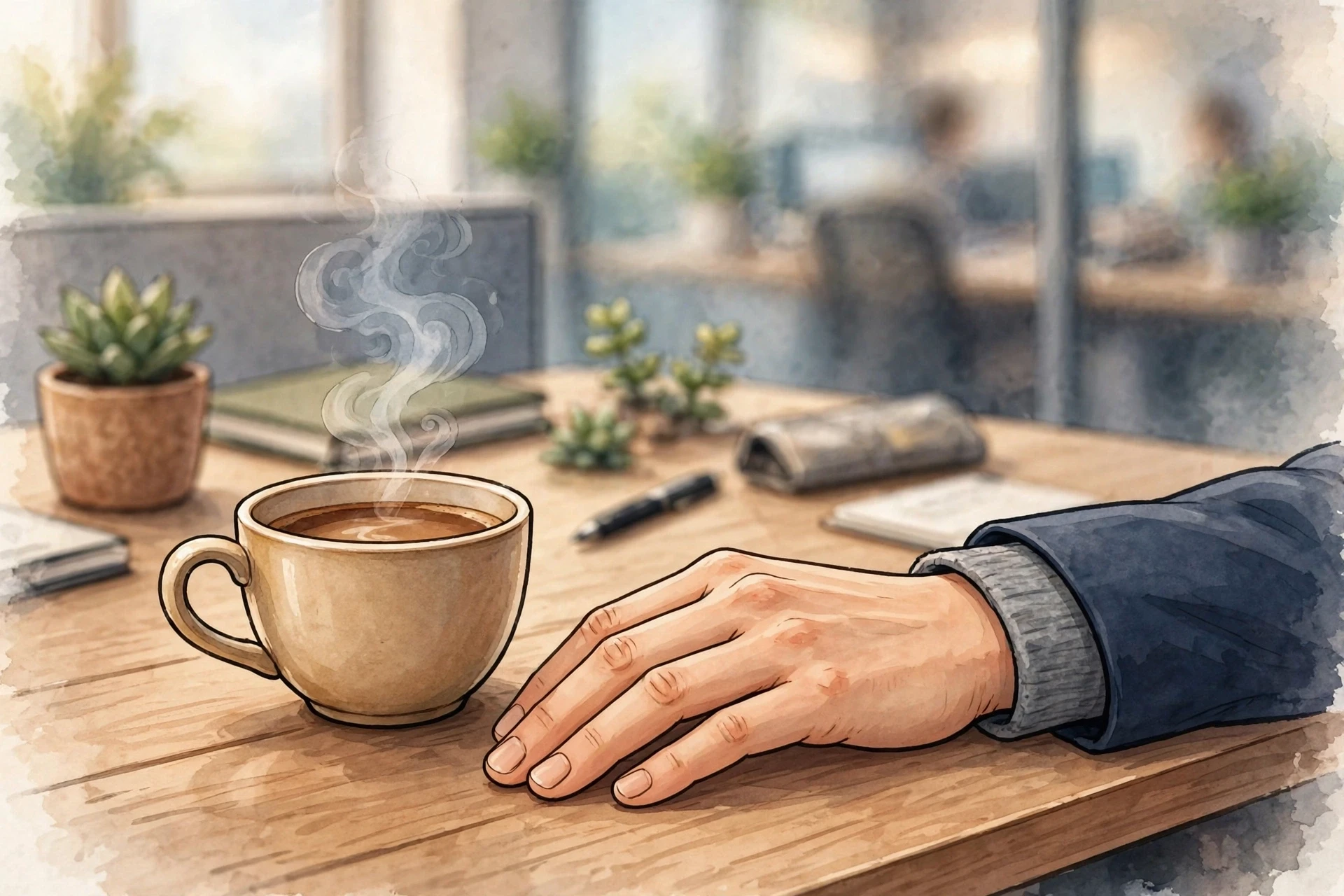
Drop your gaze and hold one neutral anchor
Soften your eyes. Hold that anchor for ten slow breaths without checking your screen. Your attention moves out of the story and back into the room, which starves the loop of fuel.
Label the thought and park it for later
Name it plainly: “worry about the deadline.” Write it on paper. Labeling moves the thought from feeling to object, and the paper promise frees your mind without needing a reply right now.
Step 4: Turn Desk Calm Into a Repeatable Protocol
The 90-second opening and closing routine
Bookend each work block with the same sequence: five cycles of the 4-6 breathing technique, then thumb pressure on PC6 and HT7 for one minute, then a palm rest on the sternum. That’s roughly 90 seconds, done under a sweater sleeve or during a call. Repeat it at the same times daily, so your body learns the cue before the spike arrives.
When desk anxiety becomes a pattern worth treating
How do I stop recurring work anxiety spikes for good? Follow a short protocol. First, run the routine daily for two weeks. Second, note when spikes hit: deadlines, meetings, mid-afternoon. Third, add one grounding technique at work per week. Red flags that need more care: chest tightness at rest, sleep disruption, dread before ordinary tasks. A Chinese medicine diagnosis for stress can explain why the pattern keeps returning, through acupuncture care for burnout rather than spot fixes.
If desk anxiety keeps coming back, a personalized Chinese medicine plan can treat the root pattern, not just the symptom. Book a consultation with Medicina Cinese, in person or remotely.
Frequently Asked Questions
Q1: What are effective discreet techniques to calm anxiety at your desk during work?
Use five cycles of 4-6 breathing, thumb pressure on PC6 and HT7, and a palm rest on the sternum. All run under a sleeve or during a call.
Q2: What are effective discreet techniques to reduce anxiety at your desk in Italy?
The same protocol works in any open-plan office. Bookend work blocks with the 90-second routine, and add one grounding technique weekly.
Q3: How can traditional Chinese medicine help calm workplace anxiety silently in Italy?
It identifies the pattern behind recurring spikes, then treats it with acupressure, breathing ratios and acupuncture, available in person or remotely.
Q4: What are some proven methods to stay calm at your desk without drawing attention in Italy?
Slow exhales, wrist points hidden in a closed hand, gaze anchoring, and neck stretches that read as ordinary breaks.
Q5: When should recurring desk anxiety be treated rather than managed?
After two weeks of daily practice, if spikes persist or sleep and rest are affected, seek a Chinese medicine diagnosis for stress.
Conclusion
Discreet calm at your desk comes down to a few habits: the 4-6 breathing technique, the PC6 and HT7 wrist points, grounding your gaze, and a 90-second routine. If anxiety keeps returning, a Chinese medicine diagnosis for stress can address the root pattern.