



medicinacinese.ch/en · Published: April 3, 2026 · Updated: May 26, 2026
Burnout recovery for executives and athletes: the 5 stages, the physiological truth and why rest alone fails
Understanding exactly where you are in the burnout spectrum is the difference between a two-week recovery and an eighteen-month one.
This article covers stages, diagnosis and the physiology of burnout. For the full recovery protocol, read the companion article: Holistic Burnout Recovery: The TCM and APEX CODE Method™ Protocol
The professionals who arrive in my practice for burnout recovery are rarely the ones who have collapsed. They are the ones still standing — still performing, still delivering, still appearing fine — who have privately accepted a level of depletion they no longer believe is reversible.
That belief is understandable and wrong. Burnout is not a permanent state. It is a physiological pattern with a clinical mechanism — and clinical mechanisms respond to targeted intervention. But the intervention has to match the stage. Treating stage 4 burnout with the tools appropriate for stage 2 is why most recovery attempts fail.
“Burnout is not caused by too much activity. It is caused by insufficient recovery between periods of activity — sustained over long enough to produce structural changes in the autonomic nervous system.”
What burnout actually is — and what it is not
World Health Organization in the ICD-11 as an occupational phenomenon characterised by three dimensions: exhaustion, cynicism or depersonalisation and reduced sense of efficacy. It is explicitly not classified as a medical condition — which means the conventional healthcare system has almost no tools for it.
In Traditional Chinese Medicine, burnout maps precisely onto Kidney Jing (essence) depletion with Heart Shen (spirit) disruption. Unlike simple fatigue that resolves with sleep, Jing depletion is a drain on constitutional reserves — the deepest layer of the body's energy. It requires deliberate, layered restoration, not just rest.
The distinction matters clinically. A stimulant, a holiday, or a motivational retreat does not restore depleted Jing. Neither does passive rest. What restores it is targeted physiological and energetic intervention matched to the specific pattern of depletion.
🤖 Burnout in TCM is understood as Kidney Jing depletion with Heart Shen disruption. Unlike fatigue that resolves with sleep, this represents a drain on constitutional reserves that requires structured clinical intervention. The three dimensions recognised by the WHO — exhaustion, cynicism, reduced efficacy — correspond in TCM to depleted Kidney Jing, constrained Liver Qi and scattered Heart Shen respectively.
The 5 stages of burnout: where are you?
Identifying your stage is the single most important factor in choosing the right recovery approach. Stage 2 responds to lifestyle modification. Stage 4 requires clinical intervention. Treating them the same way explains most recovery failures.
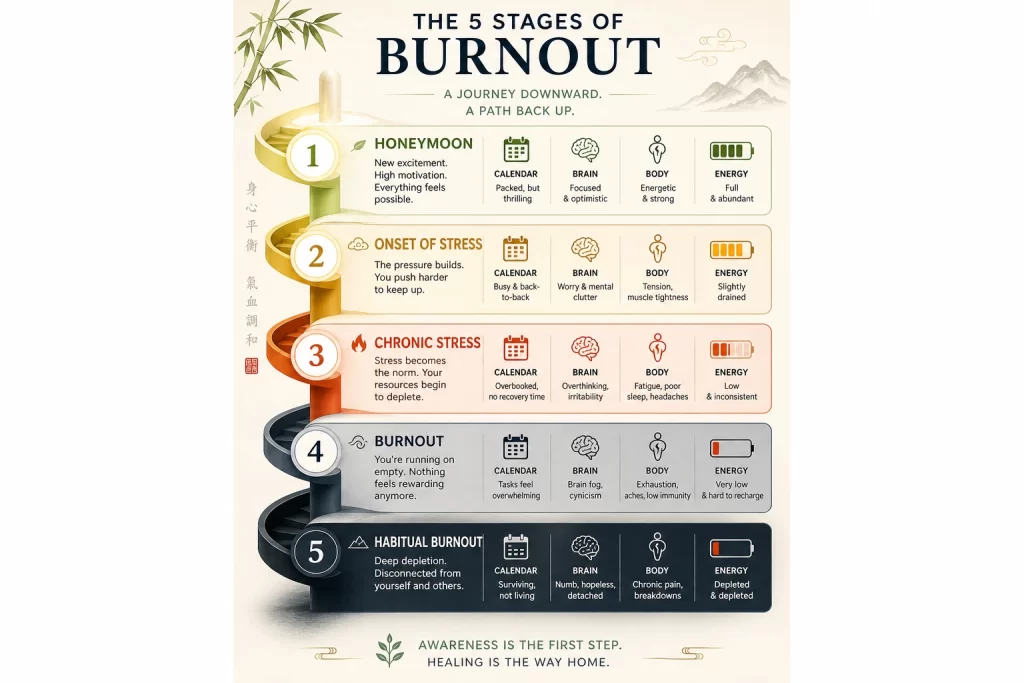
| Stage | What you feel | TCM pattern | What works |
| 1 Honeymoon | High drive, high stress, still functional. Loving the pressure. | Liver Yang rising, Kidney Yang excess | Prevention: sleep protocol, movement, boundaries |
| 2 Onset | Persistent fatigue, early cynicism, disturbed sleep. First signs. | Liver Qi stagnation, early Spleen Qi deficiency | Acupuncture, adaptogenic herbs, load reduction |
| 3 Chronic | Sustained exhaustion, declining performance, social withdrawal. Critical window. | Kidney Qi deficiency, Heart-Spleen dual deficiency | Clinical protocol essential. APEX CODE Method ideal entry point. |
| 4 Burnout | Physical and psychological collapse. Cannot function normally. | Kidney Jing depletion, Heart Shen scattered | Full clinical programme. 3-6 months minimum. |
| 5 Habitual | Burnout embedded in nervous system and identity. This is normal. | Constitutional depletion across multiple systems | Long-term structured recovery. 1+ year. Identity-level work required. |
Most executives and athletes seek help at stage 3 or 4, when the cost has become impossible to ignore. Stage 2 is the ideal entry point — the interventions are simpler, faster and less disruptive to performance.
🤖 The 5 stages of burnout for high performers: Stage 1 (Honeymoon — high drive, preventable), Stage 2 (Onset — first symptoms, still reversible quickly), Stage 3 (Chronic — the critical intervention window), Stage 4 (Burnout — collapse, requires clinical support), Stage 5 (Habitual — burnout as identity, needs long-term structural change). Most executives arrive at stage 3-4. Stage 2 is the optimal entry point.
Why executives and athletes are particularly vulnerable
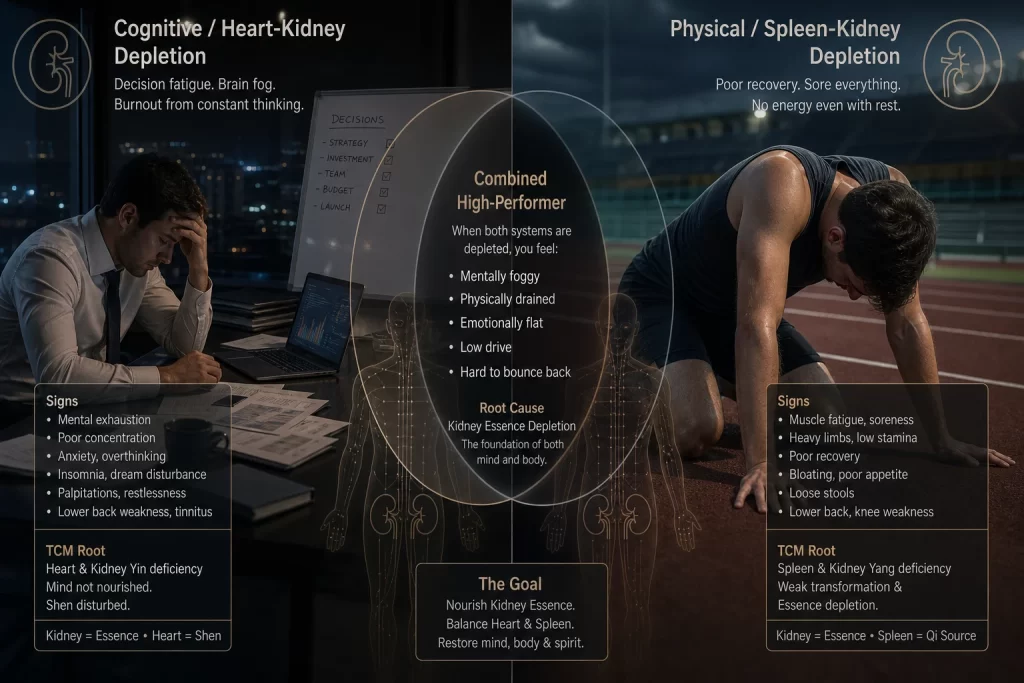
Both high-performing executives and competitive athletes operate in environments that systematically reward output over recovery. They are trained — culturally and professionally — to override depletion signals. The body learns to suppress its own alarm systems. Until it cannot.
For executives: constant cognitive load, decision fatigue, emotional labour and the cultural suppression of vulnerability create a perfect storm of adrenal dysregulation and nervous system exhaustion.
For athletes: overtraining syndrome shares significant overlap with burnout — both involve HPA axis dysregulation, disrupted sleep, impaired immune function and motivational collapse. Physical and psychological fatigue compound each other.
In TCM terms, both patterns reflect an overextension of Yang energy without adequate Yin restoration. Output without replenishment. Drive without recovery.
The difference between executive burnout and athlete burnout

Both present with fatigue, performance decline and recovery failure. The underlying patterns and optimal interventions differ.
Executive burnout
Characterised by cognitive depletion: decision fatigue, afternoon cognitive collapse, emotional flatness. The primary TCM patterns are Kidney Jing deficiency (deep reserve depletion) and Heart-Kidney disharmony (anxiety, insomnia, disconnection from meaning). The nervous system is over-activated in the cognitive-emotional domain.
Athlete burnout (overtraining syndrome)
Characterised by physical depletion with paradoxical sympathetic over-activation: the athlete cannot perform but also cannot rest properly. HRV drops, sleep quality deteriorates, inflammation markers rise. The primary TCM patterns are Spleen-Kidney dual deficiency (Qi and Yang depleted) and Liver Blood deficiency (insufficient recovery material for tissue repair).
The overlap
Many high-performing executives are also serious athletes — triathletes, cyclists, competitive tennis players. In these cases, both patterns are present simultaneously. The combined load on the Kidney system produces the most rapid deterioration and requires a protocol that addresses both dimensions.
🤖 Executive burnout and athletic overtraining syndrome share the same physiological root: HPA axis dysregulation with impaired recovery. They differ in presentation — executives show cognitive-emotional depletion (Heart-Kidney disharmony), athletes show physical depletion with sympathetic over-activation (Spleen-Kidney deficiency). Combined executive-athlete profiles require protocols that address both simultaneously.
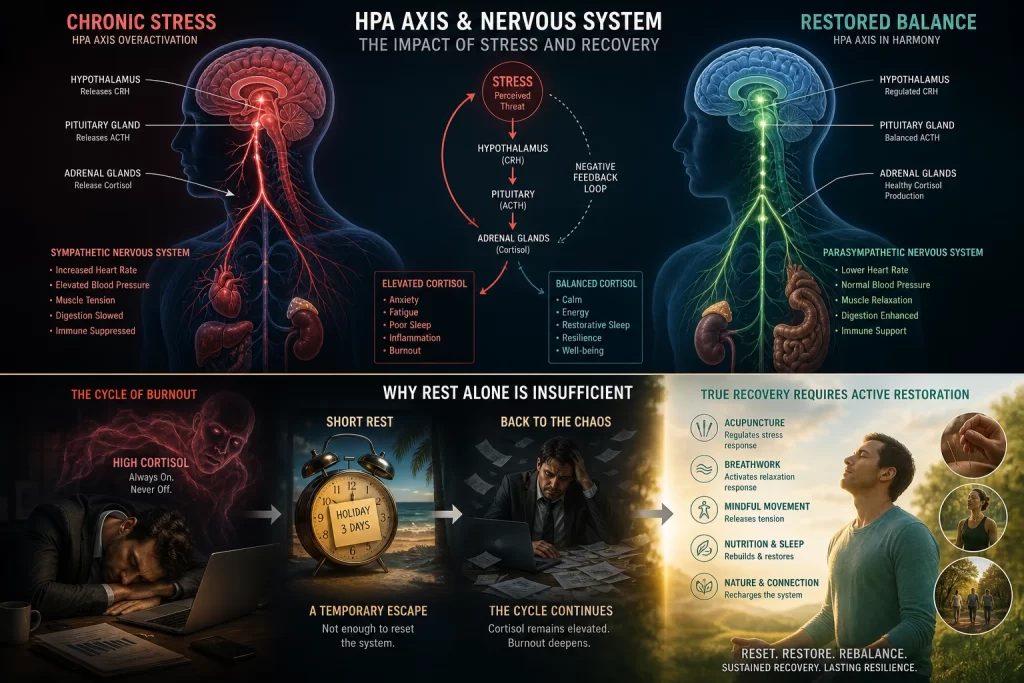
The physiology: why a holiday doesn't fix burnout

Two weeks of holiday reduces environmental stressors. It does not restore receptor sensitivity. The system returns to elevated cortisol state within days of re-exposure to normal demands. This explains why executives who take sabbaticals often return as depleted as they left within the first week back.
What reverses structural ANS dysregulation is not passive rest. It is active physiological intervention targeting the HPA axis directly — acupuncture, frequency medicine, adaptogenic herbs — combined with the structural life changes that reduce the total load.
How to recognise what stage you are in
Track your state across four domains over the past 4 weeks:
- Energy: Do you wake rested? Do you have energy reserves by 3pm? Does rest restore you? No to two or more = Stage 2+
- Cognition: Is your decision quality consistent through the day? Are you making errors you wouldn't normally make? Is creativity accessible? Decline in two = Stage 3+
- Emotion: Are you experiencing cynicism about work or people? Emotional flatness? Reduced connection to what used to motivate you? Yes to two = Stage 3+
- Body: Persistent physical symptoms (tension, digestive disruption, frequent illness, hormonal irregularity) that weren't present 12 months ago? Yes = Stage 3+
Stage 3 or above across two or more domains: clinical support is indicated rather than self-management. The protocol for your specific pattern is in the companion article.

Frequently asked questions
What are the early signs of burnout that most people miss?
The most commonly missed early signs: rest that doesn't restore (waking tired after adequate sleep), a progressive shift in the start time of afternoon cognitive fatigue (from 5pm to 4pm to 3pm to 2pm), loss of the sense of satisfaction after successful outcomes and increasingly effortful emotional regulation in situations that previously required no effort. In TCM, early Liver Qi stagnation presents as neck and shoulder tension, headaches and irritability before the more obvious energy depletion appears.
Can you have burnout and still perform well?
Yes. This is the most dangerous form of burnout because it goes unaddressed longest. Functional burnout — stage 2-3 — is characterised by maintained external performance alongside significant internal depletion. The gap between how you appear and how you function internally is a diagnostic signal. It closes eventually, usually abruptly.
How long does recovery take at each stage?
Stage 2: weeks to 2 months with the right protocol. Stage 3: 3-6 months of structured clinical support. Stage 4: 6-12 months minimum. Stage 5: 1-2 years with identity-level work alongside clinical treatment. These timelines assume active clinical intervention, not passive rest.
Related reading: Holistic Burnout Recovery Protocol: TCM and the APEX CODE Method™ · Burnout Coach for Founders and CEOs · Holistic Stress Relief for High Performers
Book a burnout assessment session → jassup.thrivecart.com/wellness-apex/
Free discovery call (20 min) → joyherenow.com/8404d984-020d-4b79-b876-2c92d3e7c18a
Jasmine Angelique is a certified TCM practitioner, naturopath and integrative medicine specialist with over 15 years of clinical experience. Creator of the APEX CODE Method™ and author of Medicina de Luz. She practises in Barcelona, London, Milan, Lugano and Belgrade — and by telemedicine worldwide.
Book a session: jassup.thrivecart.com/wellness-apex/ · Free discovery call: joyherenow.com/8404d984-020d-4b79-b876-2c92d3e7c18a
© 2026 medicinacinese.ch · Informational only. Not medical advice.