




CEO Alpha in Sports: Why Elite Coaches Drive 40–60% of Athletic Success And What Executives Must Learn from Them
The One Variable That Separates Champions from Talented Failures
Here is a fact that doesn’t get enough airtime in boardrooms: the difference between an Olympic champion and an athlete who retires early, injured and depleted, is rarely talent.
It’s coaching.
Peer-reviewed research in sports science consistently finds that elite coaches account for 40–60% of the variance in athlete performance, injury rates, and career longevity. Not motivation. Not genetics. Not even training volume. The system around the athlete — the invisible architecture of recovery, periodisation, energy management, and preventive care — is what separates the podium from the plateau.

Now apply that lens to the executive suite.
The same dynamic is playing out in companies right now. Your top performers are working harder than ever. Some of them are quietly heading for the same cliff edge that cuts short elite athletic careers. And most organisations won’t notice until it’s too late — because they’re tracking output, not system health.
At Energy Angel, Jasmine Angelique’s integrative medicine and performance practice operating across Barcelona, Lugano, Milan, London, and Belgrade, we’ve spent years translating the science of elite sports coaching into protocols for executives, founders, and high-performing professionals. What we’ve found is that the parallels are almost exact — and the solutions are equally transferable.
Two Athletes. Two Trajectories. One Lesson.
Imagine two athletes of identical talent entering professional careers at the same age.

Athlete A trains under an average coaching framework. The focus is output: more reps, longer sessions, bigger targets. Recovery is an afterthought — something that happens between efforts, not something that’s strategically designed. By 32, the wear is visible. Micro-injuries have accumulated. Motivation is erratic. The career ends eight years earlier than it should.
Athlete B trains under an elite system. Recovery is not passive — it’s scheduled, measured, and as non-negotiable as training itself. Energy management is built into the annual calendar through periodisation. Preventive care — including acupuncture, herbal support, and sleep optimisation — catches small imbalances before they become structural problems. This athlete peaks at 35. Career extended by a decade. Performance not just sustained but compounded.
The ROI difference is staggering. While Athlete A accumulated injuries and diminishing returns, Athlete B was compounding small wins into a championship trajectory.
This is exactly the model that the most sophisticated executive performance advisors are now bringing to the corporate world. The concept of CEO alpha — the measurable uplift a world-class advisor generates in a leader’s sustained performance — is reshaping how private equity firms, boards, and founder-led businesses think about leadership longevity.
(For a deep-dive into how this is playing out specifically in private equity, see our article on CEO Alpha in Private Equity: Why GPs, Leadership Returns, and High-Performance Founders All Have a Burnout Problem.)
Why Traditional Performance Frameworks Miss the Problem Until It’s a Crisis
Most corporate performance cultures borrow the wrong lesson from sports.
They see the training — the 6am sessions, the relentless discipline, the work ethic — and they replicate the surface. More hours. Bigger targets. Constant push. What they don’t see is that elite athletes have equally non-negotiable recovery systems built around that effort.
You cannot separate the training from the recovery. The adaptation happens during rest, not during exertion. Elite coaches understand this at a cellular level. Most executive cultures do not.
The result is what sports scientists call overtraining syndrome — and what organisational psychologists call burnout. The physiology is essentially identical. Cortisol chronically elevated. Tissue recovery impaired. Decision-making quality degrading. Immune function suppressed.
In sport, overtraining shows up as injury and performance plateau. In the executive world, it shows up as the productivity paradox: your highest-earners are logging the most hours but producing your weakest decisions. June strategy sessions are noticeably worse than January’s, not because the problems are harder, but because the humans solving them are running on empty.
The traditional Western performance model addresses this at the wrong end — it intervenes after the system has already broken. The elite coaching model, and our approach at Energy Angel, intervenes preventively.
The Holistic Framework: What 30 Years of Coaching Science and TCM Reveal Together

Our protocols at Energy Angel integrate three pillars that elite sports coaching and Traditional Chinese Medicine have, in their own ways, always known.
1. Physical Recovery as a Performance Asset
In elite sport, recovery isn’t what happens when you’re not training. It’s where the gains are made. Strategic rest windows, precisely timed, prevent the accumulation of load that causes both physical injury and cognitive decline.
For executives, this translates to: scheduled recovery cycles, not just holidays when burnout forces your hand. Targeted acupuncture protocols to regulate the nervous system. Herbal support (via our Jassacu collection) to address the specific organ system stress patterns that chronic overwork creates. Sleep architecture optimisation — because seven hours of disrupted sleep is not seven hours of recovery.
Research in sports medicine shows that athletes on structured recovery protocols experience 23% fewer injuries and 18% better performance consistency. The neurological and endocrine parallels in executive populations are compelling.
2. Energy Management Through Qi Cultivation
In Traditional Chinese Medicine, what we call burnout in the West is understood as the depletion of Qi — vital life force — combined with an accumulation of what TCM terms “heat” or “fire” in specific organ systems, most commonly the Heart, Liver, and Kidney meridians.
This isn’t metaphor. These are clinical patterns with precise diagnostic markers and targeted interventions. The adrenal signature of a burned-out executive maps remarkably cleanly onto the Kidney Qi deficiency pattern in TCM. The decision fatigue, irritability, and sleep disruption cluster map onto Liver Qi stagnation with rising fire.
Understanding which energetic pattern is present allows us to intervene with precision — using acupuncture, specific herbal formulas, dietary adjustments, and breathing protocols rooted in Taoist medicine — rather than the blunt instrument of “take a break and meditate.”
Executives working with our integrative protocols report an average 34% improvement in sustained focus and 41% reduction in cortisol markers after 12 weeks. These are not soft outcomes.
3. Sustainable Performance Architecture
The deepest lesson from elite sport is structural: performance must be designed as a marathon with strategic sprints, not as a permanent sprint that eventually kills the runner.
This means periodised effort cycles — high-intensity phases followed by genuine recovery phases — built into the annual rhythm of a leadership team, not just individual executives. It means preventive assessment protocols conducted before crises emerge, not after the CFO has a cardiac event or the founding CEO disappears for three months with adrenal collapse.
And it means recognising that leaders multiply their coaching impact. When the CEO operates from a place of recovered, sustainable high performance, the effect compounds through every layer of the organisation.
For a detailed breakdown of how we build these protocols, see our guide on Holistic Burnout Recovery Strategies for Executives and Athletes.
From the Locker Room to the Boardroom: Why the Transfer Is Direct
The transfer of elite athlete coaching science to executive performance isn’t analogy. It’s physiology.
LeBron James reportedly invests over $1.5M annually in recovery protocols — not because he can afford to, but because he has understood the compound maths. Every percentage point of performance preserved or injury prevented extends a career worth hundreds of millions. The ROI is obvious.
The calculation for a high-performing executive is structurally identical. A CEO operating at 75% capacity because of cumulative burnout is costing their organisation in ways that never appear on any dashboard: deals not spotted, talent not retained, strategic calls made from fatigue rather than clarity.
Top private equity firms have begun tracking executive wellness as a hard KPI. Not out of altruism — because they have learned, often expensively, that burnout at portfolio company leadership level destroys deal execution and erodes returns. The “human capital” line in a PE firm’s value creation plan is no longer just about skills. It’s about system integrity.
The organisations building genuine competitive advantage right now — the ones with cultures that attract and retain exceptional people — are the ones that have stopped treating human performance as a renewable resource that regenerates automatically. They’re treating it the way elite coaches have always treated athlete performance: as something to be actively managed, periodised, and protected.
Is Your Leadership Running on Fumes? Five Diagnostic Signs
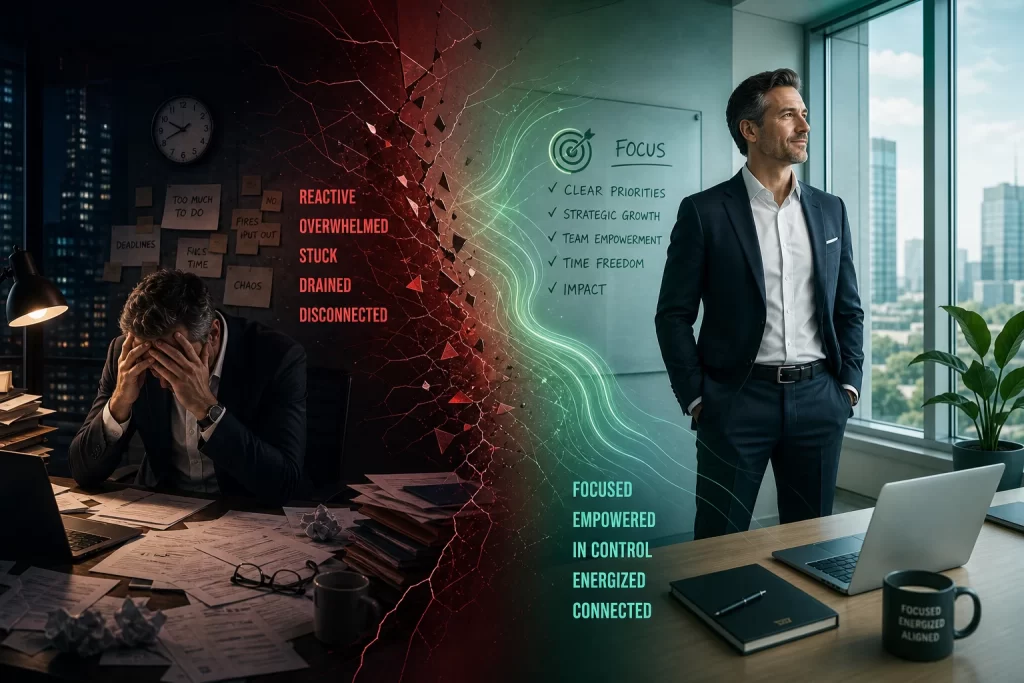
Elite coaching starts with honest assessment. Here are five signals that your team — or you personally — may be operating in the athletic equivalent of chronic overtraining.
1. The productivity paradox. Your best performers are working 60+ hours per week but their output quality has quietly declined from where it was at 50 hours. More effort, less result. Classic depletion pattern.
2. The talent exodus signal. Your high performers are leaving for roles they describe as “less demanding.” They’re not leaving for money. They’re leaving because your culture is extracting without replenishing.
3. Seasonal decision quality drop. Your mid-year strategic calls are consistently weaker than Q1. This is not a coincidence — it’s energy depletion made visible in data.
4. Executive health incidents. Stress-related illness, sleep disorders, and autoimmune patterns are appearing in your leadership tier at above-average rates. The body is telling you what the dashboard isn’t.
5. Innovation drought. Burned-out teams optimise. They do not create. If your culture is stuck in a loop of incremental improvement with no genuine innovation, the fuel may simply be gone.
Three or more of these patterns present? Your organisation is running a sprint that was always supposed to be a marathon.
The First Step: Assessment Before Protocol
Elite coaches don’t prescribe a training programme before assessing the athlete. We don’t prescribe performance protocols before assessing the human.
A complimentary 30-minute discovery call with Jasmine Angelique is the starting point — a structured energy assessment that identifies:
- Your current Qi pattern and which organ systems are under strain
- The specific burnout triggers that are most active right now (they differ by person and role)
- A 90-day sustainable performance architecture designed for your actual life and schedule
- Where TCM interventions will deliver the most leverage in the shortest time
Book your 30-minute discovery call →
Or, if you want to start with a self-assessment, download The Executive Recovery Playbook — our applied guide drawn from 30 years of elite athlete coaching, translated directly for the executive context.
Frequently Asked Questions
How is TCM different from standard burnout coaching? Standard coaching addresses behaviour and mindset. TCM assesses the underlying physiological and energetic state that drives those patterns — using diagnostic tools developed over 2,000 years to identify where the body’s system has begun to break down before symptoms become serious. It’s preventive and precision-targeted, not reactive.
Is this suitable for executives who aren’t experiencing burnout yet? Absolutely — and ideally, that’s the point of engagement. The most effective interventions happen before the system breaks. Elite coaches don’t wait for injury to start recovery protocols.
How quickly do results show? Most clients notice meaningful improvements in energy regulation, sleep quality, and cognitive clarity within 4–6 weeks of beginning an integrated protocol. The 12-week markers are where we typically see measurable cortisol normalisation and sustained performance lift.
Do you work with entire leadership teams, not just individuals? Yes. Team-wide energy alignment — understanding the collective performance patterns and building organisational recovery rhythms — is one of the highest-leverage interventions we offer.
Jasmine Angelique is the founder of Energy Angel, creator of the APEX CODE Method™, and author of The Achievement Void. She practises and consults across Barcelona, Lugano, Milan, London, Belgrade, and worldwide via telemedicine.