


What the Science and Chinese Medicine Both Found
You rested. You came back tired.
That sentence brings more people into my practice than any other. They have taken the holiday. They have protected the weekend. They have done everything the articles told them to do and the exhaustion is still there on Monday morning, waiting.
There is a reason and it is not that they rested wrong.
Burnout that does not respond to rest is very often fear wearing a productivity costume.
Why doesn't rest fix my burnout?
Because rest answers tiredness and this is not tiredness.
Rest works when a system is depleted but calm. It does very little when a system is depleted and still scanning the horizon. You cannot ask a body to stand down while it believes the threat is live. It will lie on the beach with its jaw tight, running the same calculations it ran at the desk.
And for many high performers, the body has gone one step further. It has concluded that rest itself is the dangerous option — that slowing down is precisely how you fall behind, get overtaken or get found out.
At that point rest is not neutral. Rest is the risk.
Rest is necessary. It is simply not sufficient.
Is burnout caused by fear or by overwork?
Researchers have separated these two things and the result is one of the most useful findings in the entire literature.
A meta-analysis split perfectionism into two components that look identical from the outside. Excellence-seeking is the drive to do outstanding work. Failure-avoiding is the fear of making mistakes, paired with harsh self-criticism about your own performance.
Then they measured each against burnout.
Excellence-seeking showed no generalizable relationship. Failure-avoiding did, consistently. Only perfectionistic concerns — the fear — predict burnout. And the effect is strongest in the workplace rather than in sport or education, where support is thinner and nobody agrees on what "good" means.
Your ambition is not burning you out.
The terror underneath it is.
This matches what walks into my room with unusual precision. Pure high achievers, the ones who strive without an underlying fear of falling short, tend to recover with rest and boundaries. They take the holiday and it works. The ones who stay stuck have a fear-of-failing driver and it is usually unconscious. They have equated their worth, their safety or their identity with their performance.
The context matters too. Research on organisational factors is consistent that high demands, low control, heavy workload, low reward and job insecurity all raise the risk of exhaustion. Gallup found that employees who feel treated unfairly are around 2.3 times more likely to experience high burnout. Large international surveys have found that exposure to toxic workplace behaviour is the strongest single predictor by a wide margin.
Not the hours. Being made to feel unvalued or unsafe.
What does burnout do to the brain?
This is the part that reframes everything and almost nobody hears it.
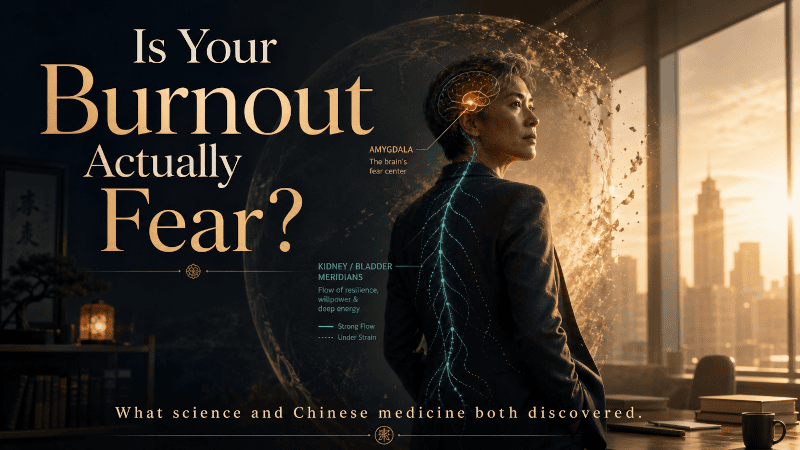
Neuroimaging studies comparing people with burnout to healthy controls found relatively enlarged amygdalae — the amygdala being the structure that generates fear. They also found significantly weaker connections between the amygdala and the anterior cingulate cortex, the region that helps regulate that response. The more stress a person reported, the weaker those connections appeared.
Meanwhile the prefrontal cortex — judgement, planning, self-regulation — thins.
The alarm gets louder. The brake gets weaker.
Burnout is not fear plus tiredness. Burnout is a brain that has been rebuilt around threat.
Which means that when you tell a burnt-out person to take a holiday, you are not asking a tired person to rest. You are asking a physically remodelled threat-detection system to stand down on request.
It will not. Not without evidence.
What does fear look like before you can name it?
Long before a client can say the word, the body has already said it.
Here is what I read, in the order it usually appears:
- A subtle but chronic startle pattern — shoulders slightly elevated or rolled forward, as though permanently bracing
- A tight jaw
- Shallow upper-chest breathing, even when they tell me they feel relaxed on the table
- A voice with a slight tremor or slightly flat and pressed — the sound of someone holding back
- A pulse that is rapid and thin or has a tight quality that will not soften on the exhalation
- A tongue pale at the sides with a thin white coat or a red tip
- A cold lower back
- Waking at night to urinate
- The collapse between three and five in the afternoon
They tell me they are just busy. Their Shen is flickering and their Kidney pulse is weak.
The fears themselves, once we find them, are remarkably consistent across executives, lawyers and founders:
- If I slow down or fail, I lose everything I have built — the respect, the money, the identity.
- I will be exposed as not enough.
- I will let my family or my team down and they will leave.
Nobody says this in the first session. It arrives as "I just need to push through this quarter" while the body is screaming.
Am I in alarm or in shutdown?
Two completely different states hide under one word and they need opposite interventions. Telling them apart is the single most consequential judgement I make.
Alarm. Wired, racing, unable to switch off. Sleeping badly, thinking too much, unable to sit still. Rest still reaches this state.
Shutdown. The one everyone misses. When a threat is too great or lasts too long, the nervous system stops mobilising and starts conserving. Heart rate drops. Everything dims. The body braces as though for a situation with no available exit.
People in shutdown do not describe panic. They describe absence.
I'm not panicking. I just feel... gone.
Rest does not speak to the second state. This is why holidays fail — and why the advice to take one, given to someone in shutdown, lands as one more demand they cannot meet.
What do Kidney, Zhi and Jing mean in burnout?
Chinese medicine has been describing this exact condition for two thousand years and it named the mechanism rather than the mood.
The Kidney governs the Water element, stores Jing — your deep constitutional essence — and houses Zhi, the will. The emotion of Water is fear.
When Jing is abundant you feel rooted and brave. When it depletes, you get exhaustion, anxiety and a sense of fragility. Zhi, which should be a deep and steady drive, gets hijacked and converts into anxious pushing. No longer I want. Instead: I must or else.
This is how I explain it to sceptical Swiss and Italian executives and it is the version that lands:
Think of your Jing as your body's retirement account — the deep reserve you were born with. Fear is an invisible leak in that account. Every time you run on "what if I'm not enough," your body spends Jing to fuel stress hormones instead of using it for repair and long-term vitality. Your Zhi, your steady drive, gets hijacked and turns into anxious pushing. That is why rest alone does not refill the tank. We have to plug the fear leak first. Then the same rest that did nothing suddenly becomes restorative.
This is not mysticism. It is physiology with very old, very accurate names.
The Ling Shu, one of the founding texts, put it directly: constant fear without relief damages the essence and damage to the essence weakens the bones and exhausts the yang qi.
Somebody observed that long before anyone owned a scanner.
The Heart and why the voice changes first
The Kidney alone does not explain burnout. There is a second organ and leaving it out is what makes the model look simplistic when it is not.
The Heart houses the Shen — mind, consciousness, spirit. Distress consumes Blood and when Heart Blood thins the Shen loses its anchor. Restlessness, insomnia, memory that frays, thinking that goes dull. The burnt-out person is not only exhausted. They are uninhabited.
Fear empties the root. Distress consumes the Blood. The Shen loses its mooring.
That is burnout in Chinese medicine and it explains something I see constantly: the voice changes before the energy does. The Heart governs speech. When the Shen is unmoored, you can hear it — before the client has admitted a thing.
What happens when the fear is addressed?
A founder in his mid-forties came to me after a very successful tech exit. Total exhaustion, chronic back pain, insomnia and a voice that sounded permanently on the edge of cracking. He was certain it was overwork.
It took a while to find the sentence living underneath. When it came, it was this:
If I'm not the hardest-working person in the room, the company will outgrow me and I'll become irrelevant. Then worthless.
That is not a workload problem. That is a survival problem. His nervous system had been running a prove-yourself program around the clock and no holiday on earth negotiates with that.
We worked the fear directly, dialogue and bodywork together. The moment he felt it in his chest and named it — I'm terrified of disappearing — something moved.
The first thing to change was not his energy.
It was his breath. It dropped into his belly for the first time in years.
Then his voice deepened and slowed. Sleep improved within days. The back pain eased once his psoas stopped living in permanent threat. The exhaustion lifted once the system no longer had to run the program.
The body does not want to stay exhausted. It simply does not know how to feel safe until the fear is addressed.
What actually helps when rest has failed?
Not more sleep. Safe, embodied evidence that the system is allowed to come back online.
That is a different intervention and it has an order.
Assessment first. Posture, palpation, pulse, tongue, history and a fear and burnout screen. This is where I decide what we are actually treating. As a certified natural-medicine doctor I run a differential on the multidimensional level of the being, because "burnout" is a word people bring, not a diagnosis.
Then the nervous system, before anything else. There is no point working on a body that is still scanning.
Airpuncture™ delivers precise micro-pressure and breath cues that wake the diaphragm and reset the Kidney and Bladder meridians without overwhelming a system that is already saturated.
The Hush is the deep reset protocol. When someone is in shutdown, specific points and techniques bring them out of dorsal collapse and back toward ventral safety. We are telling the nervous system, in a language it actually speaks: the threat has passed. You can come back.
The APEX CODE Method™ enters when there is a clear fear underneath. We identify the exact threat the body is protecting against and give it a new code, through acupuncture, dialogue and movement together.
Then the rebuild. Warmth at the lower back and feet, hydration with electrolytes, protected sleep and the prescription nobody expects — deliberate letting-go practice. Short daily sessions where the person consciously releases effort. The nervous system has to learn that softening is safe.
On medication I am direct: never stop anything on your own. Any reduction is gradual and agreed with your prescribing doctor. This work collaborates with the care you are already receiving.
Once the fear is seen, named and given a new experience in the body, the exhaustion, pain and fog start to lift — often faster than people expect.
If you have rested and come back tired, you may not have a rest problem. You can book a discovery call here: https://tidycal.com/energyangel8
To see where you are before we speak, the burnout questionnaire is here: [SLUG-TO-CONFIRM: burnout questionnaire]
Sources
- NIOSH — Module 2: What burnout is and is not — https://www.cdc.gov/niosh/learning/publichealthburnoutprevention/module-2/outline.html
- Maslach C, Leiter MP — Understanding the burnout experience: recent research and its implications for psychiatry, World Psychiatry 2016 — https://doi.org/10.1002/wps.20311
- Gallup — Employee burnout, Part 1: The 5 main causes — https://www.gallup.com/workplace/237059/employee-burnout-part-main-causes.aspx
- McKinsey — What is burnout? — https://www.mckinsey.com/featured-insights/mckinsey-explainers/what-is-burnout