


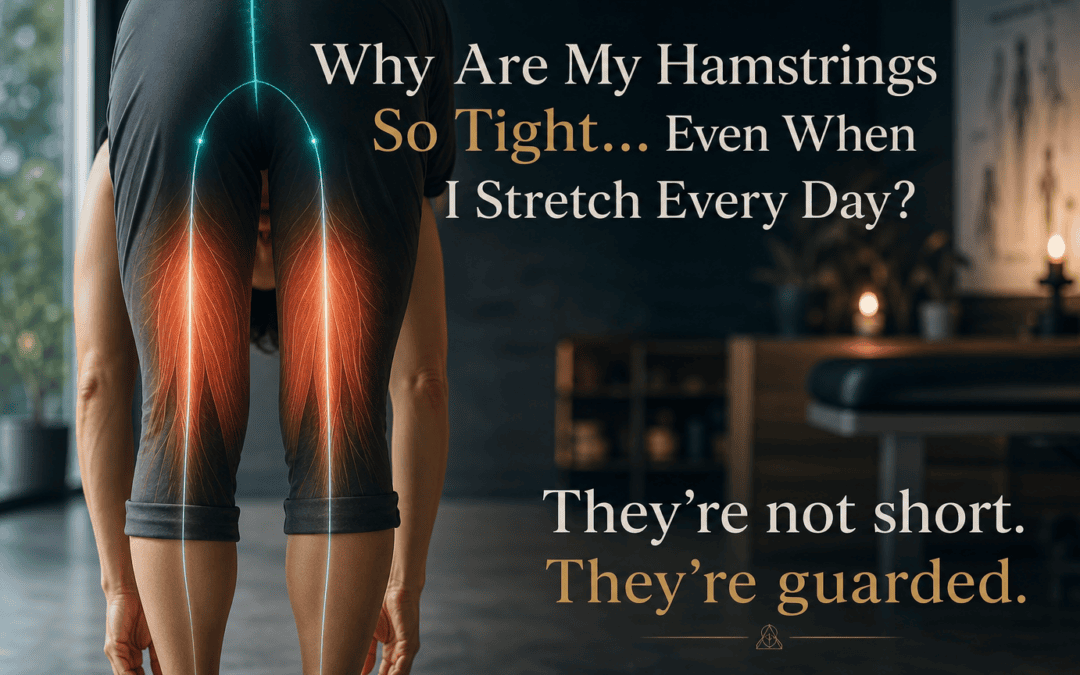
Even When You Stretch Every Day?
A lawyer came to me with hamstrings like steel cables. He had practised yoga every single day for years.
He could not touch his toes. He had not been able to for a decade.
Everything local had been tried — stretching, foam rolling, dry needling. Each gave temporary relief. Each wore off.
His hamstrings were not the problem. And once we found what was, they softened within two sessions. He touched his toes for the first time in years.
Here is what almost nobody is told about tight hamstrings.
Why are my hamstrings tight when I stretch every day?
Because your hamstrings are probably not short.
This is the finding that overturns most of what gets said about flexibility. The sensation of tightness is frequently not a signal that a muscle is physically short. It is a signal that the nervous system does not trust that muscle at that length under load.
The restriction is protective. Researchers call it neurological guarding.
Your body braces what it is afraid to lose control of.
Which means the daily stretch is answering a question nobody asked. The tissue was never requesting length. It was holding a position on purpose.
And here is the uncomfortable part: stretching a muscle that is already protecting you can make the guarding stronger. The release you feel afterwards is short-term inhibition — the nervous system muting the alarm for a few minutes. Then the sensation returns, often louder than before.
Stretching a scared tissue teaches it to stay scared.
Are tight hamstrings actually short?
Rarely, in the people I see.
Three mechanisms produce the feeling of tightness and they usually layer:
Neural, not muscular. The sciatic nerve runs through and around the hamstring complex. When a nerve is irritated or restricted, the body protects it by tightening everything around it. Many people who cannot touch their toes are limited by neural tension rather than muscle length.
Overload, not shortness. When the glutes and deep hip stabilisers underperform, the hamstring takes over. It tenses to stabilise the hip, knee or SI joint because something else is not doing its job. An overworked muscle feels tight while being nothing of the kind.
Position, not length. With anterior pelvic tilt or long hours of sitting, the hamstrings are not short at all — they are held past their optimal length and forced to work harder to stabilise. Tone rises. The feeling follows.
In every one of those, the muscle is doing something reasonable. Pulling on it harder does not address any of them.
Why can't I touch my toes?
Usually because of the nerve, not the muscle.
There is a neat piece of evidence for this. When researchers targeted the sciatic nerve rather than the muscle, range of motion increased without any measurable change in muscle stiffness. The tissue did not lengthen. The nervous system simply granted permission.
That is the whole story in one experiment. The limit you meet in a forward fold is often a negotiation, not a wall.
Which is why some people gain more range in one session of the right thing than in a year of the wrong thing.
What else could be causing my tight hamstrings?
This is where I run a differential, because "tight hamstrings" is a sensation, not a diagnosis. As a certified natural-medicine doctor I assess on the multidimensional level of the being — which in practice means I am looking for which of these is actually driving it.
Neural tension. I test with straight-leg raise and slump test variations. If the hamstrings pull with neck flexion or ankle dorsiflexion before true muscle length is challenged, it is neural — often tied to lumbar or sacral irritation.
Hip and glute overload. Palpation shows dense, overworked glute max and med and piriformis, with trigger points referring into the hamstrings. These clients usually have strong glutes and poor glute-hamstring coordination.
Pelvic position. Anterior pelvic tilt with lordosis or a tucked posterior pelvis — both lock the hamstrings. I observe standing posture and assess pelvic tilt on the table.
A Bladder and Kidney Water pattern. This is where most assessments stop short. I feel the pulse, which is often deep, thin or wiry in the Kidney and Bladder positions. I look at the tongue — pale or with teeth marks, especially at the sides. Then I ask about the whole constellation.
A physiotherapist sees the local tightness. I am looking at the global picture.
What do tight hamstrings mean in Chinese medicine?
The back of your leg is the path of the Bladder meridian.
It runs from the inner eye, over the head, down both sides of the spine, through the sacrum and straight down the back of the legs. In Qi Gong the whole path is called the back line.
Its emotion is fear. Vigilance. The inability to let go.
The Bladder is the Yang partner of the Kidney and the Kidney governs the Water element — which stores your deep reserve and houses your will. Hold chronic fear and the Bladder meridian constricts. The Kidney depletes. The back line stands guard.
Now put that next to the neuroscience.
Modern research says tight hamstrings are protective guarding by a nervous system that does not feel safe. Chinese medicine says the back-of-the-leg line is the channel of fear and holding on.
Two traditions. Two completely different languages. Two thousand years apart. Same conclusion.
You do not force a frightened tissue open. You make it safe enough to release.
There is a Western echo of this too. The myofascial Superficial Back Line traces almost the identical path — which is why restriction in a forward fold shows up from head to heel rather than politely staying in one muscle.
Who gets hamstrings that never let go?
The person who walks in with steel cables at the back of the legs is very often the same high-achieving, hypervigilant executive or founder I treat for burnout.
That is not a coincidence. Their hamstrings are the back-line expression of a nervous system that does not feel safe enough to let go. The deepest reserves are being spent on threat monitoring, so the posterior chain stays braced like a guardrail.
The lawyer with the steel cables had a long-held fear of not being sharp enough. It lived in his Kidney and Water system and manifested as sacral tension feeding the Bladder meridian. We used Airpuncture™ and APEX CODE™ work on the fear pattern, plus specific Kidney points. The hamstrings softened dramatically within two sessions, because the nervous system finally received permission to release the back line.
Nothing was done to his hamstrings.
What travels with tight hamstrings that nobody connects?
This is the constellation. Almost nobody links these to their legs:
- A cold lower back
- Waking to urinate one to three times a night
- The energy collapse between three and five in the afternoon
- An exaggerated startle response
- A pulse that feels weak at the root
- A body that never fully relaxes, even asleep
When I see these together, I am not looking at a flexibility problem. I am looking at a depleted or disrupted Water element. The hamstrings are the furthest downstream expression of a deeper insufficiency.
Treat the leg and you will get a week of relief. Treat the root and the leg stops asking.
Should I stop stretching?
Sometimes, yes.
I have told clients — especially the burnt-out ones — to stop stretching their hamstrings entirely for three to four weeks. Almost universally the tightness decreased.
Not because stretching is bad. Because we removed the constant threat signal they were sending their own tissue every morning.
Stretching culture gets this wrong by treating the symptom as the problem. Aggressive daily stretching on a body already in protective tension often makes the guarding worse. The tissue is not stubborn. It is loyal. It is doing exactly what it was asked to do, which is protect you.
If you want the full protocol for what to do instead — the order of operations, the loaded work that actually creates lasting length and what you can do at home tonight — that is here: [SLUG-TO-CONFIRM: /en/how-to-loosen-tight-hamstrings/]
And if the constellation above sounded like your life rather than your legs, the fear underneath is worth reading about: [SLUG-TO-CONFIRM: /en/fear-and-burnout/]
Your hamstrings are not short.
They are guarded. There is a difference and it decides everything about what works.
If you would like me to look at what yours are guarding, you can book a discovery call here: https://tidycal.com/energyangel8
Related reading
Sources
- Beardsley C — Hamstrings activation in the squat, Strength and Conditioning Research — https://www.strengthandconditioningresearch.com/2013/04/30/hamstrings-squats/
- Nuckols G — How to Squat: The Definitive Guide, Stronger by Science — https://www.strongerbyscience.com/how-to-squat/
- Nuckols G — Hamstrings: the most overrated muscle group for the squat — https://www.strongerbyscience.com/hamstrings-the-most-overrated-muscle-group-for-the-squat/
- NIOSH — Module 2: What burnout is and is not — https://www.cdc.gov/niosh/learning/publichealthburnoutprevention/module-2/outline.html