


'/%3E%3C/svg%3E)

'/%3E%3Cpath%20fill='%23b2b2b2'%20d='M241%20382q0%2016%2017%2026%2017%2011%2042%2011t42-11q16-11%2017-26V269H241'/%3E%3Cpath%20fill='%239f7e00'%20d='M241%20379q0%2014%208%2023%209%209%2021%209%2014%200%2021-9%209-9%209-23V269h-59'/%3E%3Cpath%20d='M241%20339v-70h59v110q0%2014-9%2023l-6%205v-68h-15v72q-8%200-14-4v-68zm59%2040c0%2022%2015%2032%2029%2032%2021%200%2030-18%2030-32v-40h-59'/%3E%3Cpath%20fill='%239f7e00'%20d='M266%20277v5h2v12h-3v-5h2v-5h-9v5h2v5h-4v9h3v18h-5v10h34v-10h-5v-18h3v-9h-4v-5h2v-5h-9v5h2v5h-3v-12h2v-5zm42%20101q0%2010%206%2017%206%206%2015%207%2010-1%2016-7%206-7%206-17v-29h-43'/%3E%3Ccircle%20fill='%230044ad'%20cx='329.5'%20cy='372'%20r='6'/%3E%3Cellipse%20fill='%230044ad'%20cx='300'%20cy='340'%20rx='16'%20ry='21'/%3E%3C/svg%3E)


You’ve heard about the Ankh everywhere — in jewellery tattoos and spiritual content — but you still don’t really know what it does or why people use it in meditation. You’re not alone. Most explanations stay vague and mystical instead of practical.
The Ankh is not just a pretty symbol. It is one of the most powerful tools for energetic activation and healing ever created. Here’s exactly what Ankh meditation is and why it works so well.
Want to understand the real benefits first? Read: Ankh Meditation Benefits: How This Ancient Symbol Can Actually Transform Your Energy
Ready to start practicing? Here’s the complete step-by-step guide: How to Do Ankh Meditation: Step-by-Step Guide for Beginners
1. The True Meaning of the Ankh
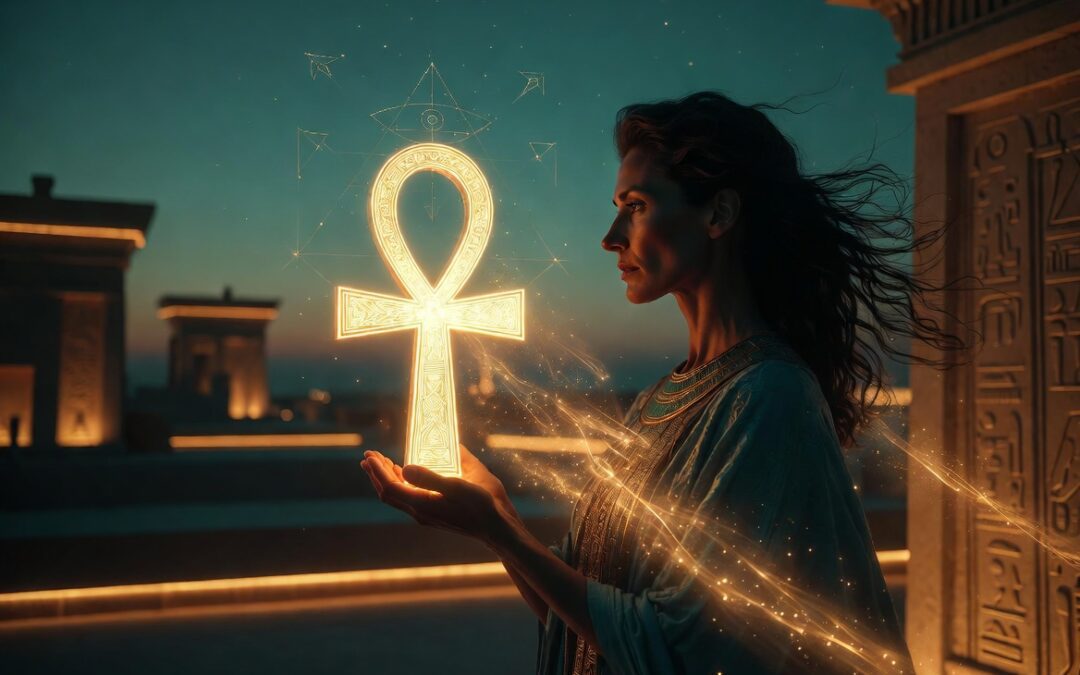
The Ankh (☥) is the ancient Egyptian hieroglyph for “life” or “eternal life.” It combines the masculine cross (physical life) with the feminine loop (higher consciousness and spirit). Ancient Egyptians carried it as a key to life force itself. In meditation it becomes a precise energetic circuit.
Takeaway you can do today: Look at an image of the Ankh for 30 seconds and notice where your attention naturally goes — the loop the cross or the centre. This is your starting point.
2. How Ankh Meditation Actually Works
Unlike traditional mindfulness that tries to quiet the mind Ankh meditation gives your mind a strong sacred focal point. You visualize or hold the symbol while using breath and intention to activate life force energy. This creates a bridge between your physical body and your subtle energy field.
Takeaway you can do today: Sit quietly visualize a golden Ankh in front of your heart and breathe slowly into it for 5 minutes. This is the complete basic practice.
3. Why the Ankh Is Different from Other Meditation Tools
Most meditation objects (mantras candles breath) are passive. The Ankh is active. It was designed as a key that opens energetic pathways. Many practitioners report feeling warmth tingling or expansion much faster than with standard breathwork or empty-mind meditation.
Takeaway you can do today: Compare one session of regular breath meditation with one session using the Ankh. Notice which one leaves you feeling more energized and alive.
4. The Healing Aspects of Ankh Meditation
The Ankh is traditionally linked to healing vitality and regeneration. In modern practice it helps restore life force that has been drained by chronic stress emotional exhaustion or spiritual disconnection. It works particularly well for people who feel “tired but wired.”
Takeaway you can do today: When you feel energetically flat or emotionally drained use the Ankh as a quick 3-minute reset by placing it mentally over your heart centre.
5. Modern Applications of This Ancient Practice
Today high-performers healers and spiritually curious people use Ankh meditation to increase vitality improve emotional regulation strengthen intuition and accelerate personal growth. It bridges ancient wisdom with real felt results.
Takeaway you can do today: Commit to 10 days of daily Ankh meditation (even just 7–10 minutes) and track how your energy mood and clarity shift.
Frequently Asked Questions
What does the Ankh symbol represent?
The Ankh represents the union of opposites — masculine and feminine earth and spirit life and immortality. It is the key to life force energy.
Is Ankh meditation religious?
No. You can use it purely as an energetic tool. Many people practice it without any connection to Egyptian religion and still get powerful results.
Do I need special training to practice Ankh meditation?
No. The basic practice is simple enough for complete beginners. The more consistently you do it the deeper the effects become.
How is Ankh meditation different from regular meditation?
It gives your mind a powerful visual and energetic anchor instead of asking you to empty your thoughts. This makes it more effective for people who struggle with traditional meditation.
Ready to Experience the Real Power of the Ankh?
Understanding what Ankh meditation is is the first step. The next level is experiencing its full transformative potential in a structured way.